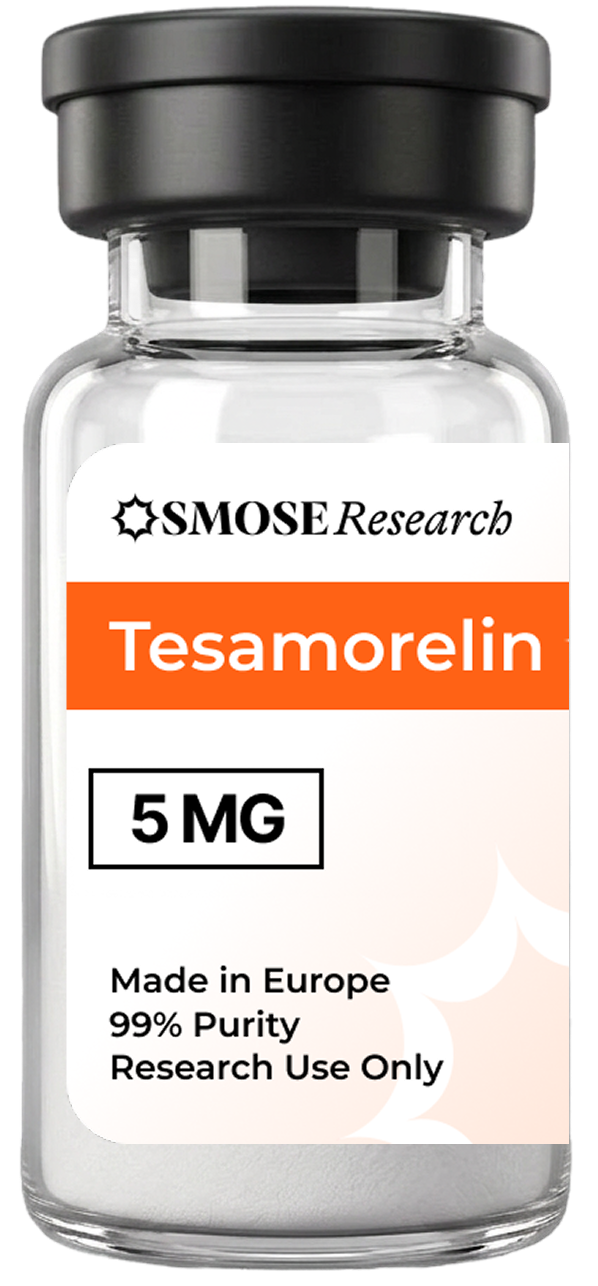
Tesamorelin
5 MGTesamorelin (TH9507 / TH-9507) — stabilized GHRH(1-44) analog for research
Studied therapeutic interests:
Tesamorelin — also referenced as TH9507, TH-9507 or tésamoréline — is a synthetic analog of GHRH (Growth Hormone-Releasing Hormone) to 44 amino acids, modified at the N-terminus by a trans-3-hexenoyl group. This acyl modification protects the peptide from cleavage by dipeptidyl peptidase-4 (DPP-4), the primary degradation enzyme of native GHRH, extending plasma half-life to approximately 26 minutes compared to less than 7 minutes for native GHRH.
Developed by Theratechnologies, tesamorelin was approved by the FDA in 2010 (EGRIFTA®) for the treatment of lipodystrophy associated with HIV infection, representing a landmark in GHRH pathway research. In preclinical studies, its mode of action is well characterized: binding to the GHRH-R receptor with nanomolar affinity, activation of the Gs/cAMP/PKA pathway, and stimulation of GH secretion by somatotroph pituitary cells.
Current research investigates visceral lipolysis, hepatic lipid metabolism and IGF-1/GH signaling pathways. In vitro, tesamorelin is used in hepatocyte cultures, 3T3-L1 adipocytes and pituitary lines to study the effects of GHRH pathway activation on fatty acid oxidation, hormone-sensitive lipase activity and somatotroph gene expression.
At OSMOSE Research, Tesamorelin TH-9507 is supplied as a lyophilized powder at HPLC purity ≥ 99.2%, accompanied by a comprehensive certificate of analysis. Manufactured in Europe under GMP standards, this research peptide is delivered to France, Belgium, Switzerland, Luxembourg and worldwide internationally with insulated packaging.
- Preclinical research on GHRH pathway and pituitary stimulation
- In vitro studies on visceral lipolysis and hepatic metabolism
- HIV lipodystrophy research (cellular models)
- Preclinical studies on non-alcoholic hepatic steatosis
- Comparative studies of GHRH analogs (tesamorelin vs sermorelin vs CJC-1295)
- In vitro research on hormone-sensitive lipase
- Studies on the somatotroph axis and IGF-1
- Preclinical research on fatty acid oxidation
Tesamorelin (TH9507, TH-9507) is a reference tool in GHRH pathway and HIV lipodystrophy research. The foundational work of Ferdinandi et al. (2007) characterized its resistance to DPP-4 and 26-minute half-life. Clinical studies by Falutz et al. (NEJM 2007) and Stanley et al. (JAMA 2014) established its specific effects on visceral adipose tissue and hepatic fat in HIV lipodystrophy, opening comparative research avenues in non-alcoholic hepatic steatosis. Research topics include: hepatic lipolysis and oxidation of fatty acids, regulation of hormone-sensitive lipase, somatotroph signaling vs bradykinin/endothelin pathways, and comparison with other GHRH analogs (sermorelin, CJC-1295).
- HPLC purity ≥ 99.2% verified by RP-HPLC
- Molecular mass certified by ESI-MS
- Endotoxin test < 0.5 EU/mg by LAL method
- Sterility validation
- Verification of trans-3-hexenoyl N-terminal modification
Frequently asked questions
Sermorelin is the native GHRH(1-29) sequence with a ~11-minute half-life. Tesamorelin is a modified GHRH(1-44) analog with a trans-3-hexenoyl N-terminal group that extends the half-life to ~26 minutes. This greater stability allows for prolonged pulsatile studies on the somatotroph axis.
The trans-3-hexenoyl group attached to the N-terminus blocks recognition by dipeptidyl peptidase-4 (DPP-4), the enzyme that rapidly cleaves native GHRH. This steric protection extends the half-life from 7 to 26 minutes in preclinical models.
Preclinical models include GH3 somatotroph lines for GH secretion, primary human hepatocytes for hepatic lipid metabolism studies, 3T3-L1 adipocytes for lipolysis, and HEK-293 recombinantly expressing GHRH-R for receptor activation studies.
Clinical studies in HIV lipodystrophy (Falutz et al. NEJM 2007, Stanley et al. JAMA 2014) show selective reduction of visceral adipose tissue and intrahepatic fat. The underlying mechanism involves activation of the somatotroph axis, lipolysis via hormone-sensitive lipase and fatty-acid oxidation in hepatocytes.
Lyophilized tesamorelin dissolves in bacteriostatic water or sterile saline. Typical in vitro concentrations are 1-100 nM. Avoid acidic pH (< 5) that could destabilize the trans-3-hexenoyl group. Stability is 28 days at 4 °C after reconstitution.
Tesamorelin binds the GHRH-R receptor with nanomolar affinity (Kd ≈ 0.5-2 nM depending on model), activating the Gs pathway → cAMP → PKA → GH1 gene transcription → GH secretion. This affinity is comparable to sermorelin and native GHRH.
Tesamorelin (EGRIFTA®) holds MA from FDA (2010) and EMA (2015) for lipodystrophy associated with HIV infection. Outside this specific indication and ANSM/EMA/FDA registered clinical protocols, any human use is prohibited. Our tesamorelin is intended exclusively for in vitro research.
Activation of the somatotroph axis by tesamorelin increases hepatic fatty-acid oxidation and reduces fat accumulation in hepatocytes. Recent preclinical and clinical studies explore this property for research on non-alcoholic hepatic steatosis (NAFLD/NASH).
Modification is verified by ESI-MS mass spectrometry, which confirms the additional 96 Da corresponding to the trans-3-hexenoyl group. RP-HPLC also allows identification of this acyl modification by its characteristic retention profile.
For quantitative GHRH-R pharmacology studies, purity ≥ 99.2% HPLC is imperative. Synthesis impurities include non-acylated forms (without trans-3-hexenoyl) and methionine oxidation products, which can alter quantitative measurements.
All products on this page are intended exclusively for in vitro scientific research and laboratory use. They are not intended for human or animal consumption, nor for diagnostic or therapeutic use. The buyer assumes full responsibility for compliance with applicable local regulations.