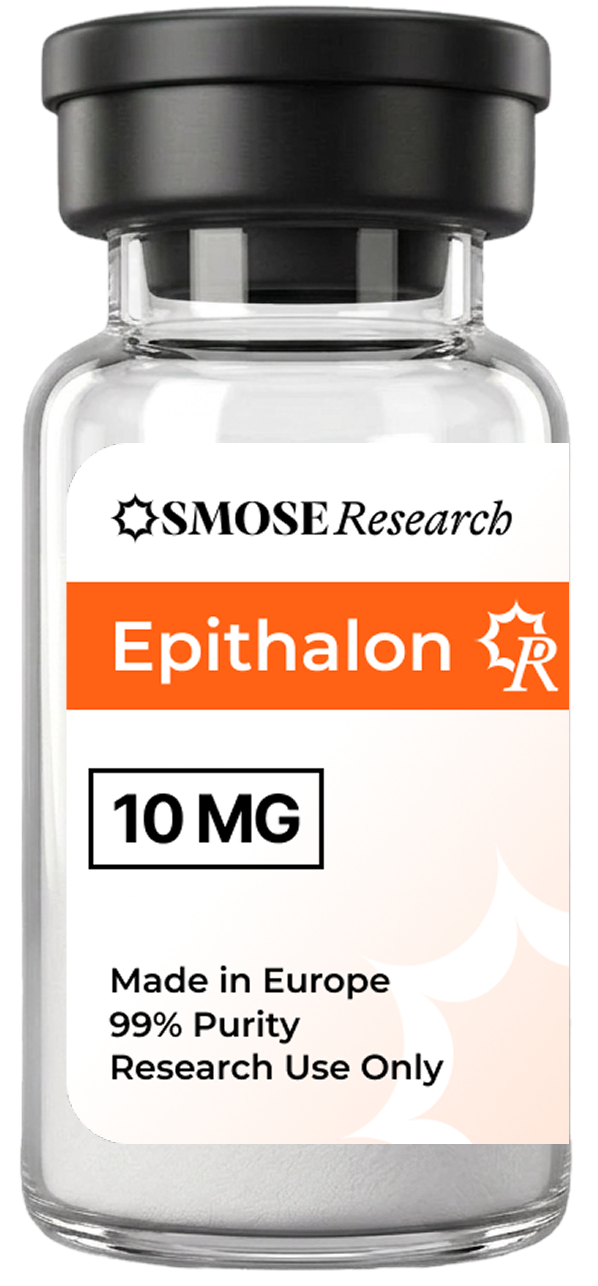
Epithalon
10 MGEpithalon (AEDG / Epitalon) — Ala-Glu-Asp-Gly tetrapeptide for longevity research
Studied therapeutic interests:
Epithalon — also spelled epitalon, epithalon or épitalon according to the transcription from Russian — is a synthetic tetrapeptide of sequence Ala-Glu-Asp-Gly (AEDG, 390.35 g/mol, CAS 307297-39-8), developed by Vladimir Khavinson at the St. Petersburg Institute of Bioregulation and Gerontology. Derived from epithalamine (a bovine pineal gland extract), it has been studied since the 1990s for its effects on telomerase reverse transcriptase (hTERT) activation, telomere length in cultured human fibroblasts and regulation of gene expression related to cellular aging.
The AEDG peptide is highly soluble in aqueous medium at neutral pH (> 10 mg/mL in ultrapure water). Its small size (4 residues, 390 g/mol) and acidic structure (Glu and Asp contribute two negative charges at pH 7) favor membrane penetration by facilitated diffusion. Stability in solution exceeds 30 days at 4 °C according to internal OSMOSE Research data.
In human embryonic fibroblast culture, incubation with epithalon at 0.01-1 ng/mL for 2-4 weeks induces a significant increase in telomerase activity measured by TRAP-assay, a 33% telomere lengthening over 14 culture passages, and overcoming of Hayflick's maximum population doubling limit. Beyond the telomerase effect, epithalon modulates expression of genes involved in senescence and oxidative stress (p53, p21^WAF1, SOD2, catalase).
At OSMOSE Research, epithalon is supplied as a lyophilized powder with HPLC purity ≥ 99.2%, accompanied by a complete certificate of analysis. Manufactured in Europe under GMP standards, this research peptide is delivered to France, Belgium, Switzerland, Luxembourg and worldwide internationally.
- Preclinical research on telomerase activation (TRAP-assay)
- Studies on senescence in IMR-90 and WI-38 fibroblasts
- Research on progeria models (Hutchinson-Gilford, Werner)
- Preclinical studies on epigenetic regulation of senescence genes
- Research on stress-induced senescence (oxidative, oncogenic)
- Studies on pineal-mimetic effects and melatonin
- Comparative research on peptides of the Khavinson family
- Preclinical studies on cellular longevity
Epithalon (AEDG, Epitalon) is a key tool in research on cellular aging and telomeres. The foundational work of Khavinson, Bondarev and Butyugov (Bull Exp Biol Med 2003) established its effect on telomerase activation and telomere lengthening in human fibroblasts (+33% over 14 passages). Research topics include: epigenetic regulation of senescence genes (p53, p21), modulation of the p16^INK4a/Rb pathway, interaction with mitotic chromatin, and pineal-mimetic effects on melatonin. Studies on progeria models (Hutchinson-Gilford, Werner syndrome) use epithalon to dissociate contributions of telomerase and DNA repair pathways. Replicative senescence induced by oxidative stress (H₂O₂), oncogene (H-RASv12) or UV irradiation in IMR-90/WI-38 models allows observation of protective effects on genomic integrity.
- HPLC purity ≥ 99.2% verified by RP-HPLC
- Molecular mass certified by ESI-MS (390.35 g/mol)
- Endotoxin test < 0.5 EU/mg by LAL method
- Sterility validation
- Sequence verification by MS/MS (AEDG)
Frequently asked questions
No. Epithalamine is a complex polypeptide extract from the bovine pineal gland, while epithalon is the synthetic tetrapeptide AEDG (Ala-Glu-Asp-Gly) isolated as the minimal active principle. Epithalon thus represents the active 'minimal' molecule of epithalamine.
Vladimir Khavinson's group demonstrated that the AEDG sequence is the minimal active motif of epithalamine, identified by Edman degradation and bioactive sequencing. This 4-residue size facilitates membrane penetration and chemical synthesis.
Khavinson studies use 0.01 to 1 ng/mL (~25 pM to 2.5 nM), very low concentrations characteristic of pineal regulatory peptides. These extremely low concentrations suggest action by specific receptors rather than by non-specific effects.
Yes, its small size (4 residues, 390 g/mol) and negative net charge at pH 7 allow membrane penetration by facilitated diffusion and possibly by the PepT1 peptide transporter, common to small oligopeptides.
Reference lines are IMR-90, WI-38 and HFF-1 (human diploid fibroblasts) for replicative senescence, progeria fibroblasts (Hutchinson-Gilford, Werner) for accelerated aging, and B16-F10 or HeLa cells for comparative telomere studies.
Beyond the telomerase effect, epithalon modulates expression of genes involved in senescence (p53, p21^WAF1, p16^INK4a), oxidative stress (SOD2, catalase) and DNA repair. Chromatin immunoprecipitation (ChIP) studies suggest interaction with specific DNA motifs.
Historically yes, due to its Soviet origin. Recent publications include English translations in Bull Exp Biol Med, Neuroendocrinol Lett and Biogerontology. Western reproducibility has been documented in some independent studies, although some results require independent verification.
Lyophilized epithalon dissolves rapidly in bacteriostatic water, sterile saline or PBS pH 7.4 (solubility > 10 mg/mL). Typical in vitro concentrations are 0.01-100 nM. Stability is 30 days at 4 °C after reconstitution.
Yes. In animal models (rats, mice), epithalon restores nocturnal melatonin secretion in aged animals and normalizes circadian rhythm synchronization. This pineal-mimetic effect, consistent with its pineal origin, has been associated with a reduction in spontaneous tumors in long-term studies.
Purity ≥ 99.2% HPLC is imperative for quantitative studies on telomerase activation. SPPS synthesis impurities include deamidation products (Asn → Asp) and diketopiperazine forms, which may interfere with low-dose effects.
Complete your research
Often ordered together by our researchers
All products on this page are intended exclusively for in vitro scientific research and laboratory use. They are not intended for human or animal consumption, nor for diagnostic or therapeutic use. The buyer assumes full responsibility for compliance with applicable local regulations.