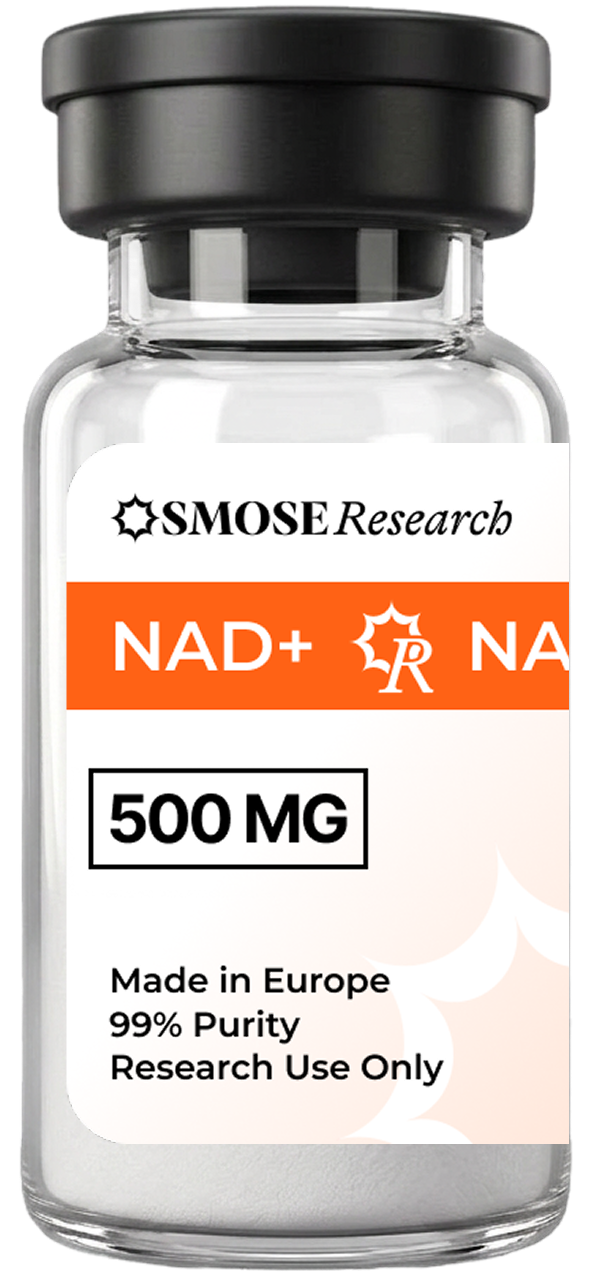
NAD+
500 MGNAD+ (β-NAD+) — Nicotinamide Adenine Dinucleotide for research on sirtuins
Studied therapeutic interests:
NAD+ (β-nicotinamide adenine dinucleotide, also noted β-NAD+ or NAD plus) is the key pyridine dinucleotide of energy metabolism, ubiquitous cofactor of oxidoreductase enzymes and substrate of sirtuins (SIRT1-SIRT7) NAD+-dependent deacetylases. It is a 663.43 g/mol dinucleotide composed of an adenosine and a nicotinamide ribonucleotide linked by a pyrophosphate bridge. Intracellular concentrations vary from 0.1-1 mM depending on tissue and cellular state.
In fundamental metabolism, NAD+ exists in two interconvertible forms — oxidized (NAD+) and reduced (NADH) — by transferring a hydride during cytosolic and mitochondrial oxidoreduction reactions. The NAD+/NADH ratio is a cellular redox status indicator, regulating glycolysis, the Krebs cycle and oxidative phosphorylation.
Beyond its role as a redox cofactor, NAD+ is the substrate for three major consuming enzymes: sirtuins (SIRT1-SIRT7) NAD+-dependent deacetylases, poly-ADP-ribose polymerases (PARP1/2) in DNA repair, and CD38/CD73 ectoenzymes. NAD+ cellular levels decline with age, contributing to aging phenotype via reduced sirtuin and PARP activity.
Research uses NAD+ to study: sirtuin pathway activation (SIRT1 → PGC-1α, mitochondrial biogenesis), replicative senescence in IMR-90 fibroblasts, oxidative stress response, and SIRT6-mediated DNA repair.
At OSMOSE Research, NAD+ is supplied as a lyophilized powder with HPLC purity ≥ 99.2%, accompanied by a comprehensive certificate of analysis. Delivered to France, Belgium and Switzerland with insulated packaging.
- Preclinical research on sirtuins SIRT1-SIRT7
- Studies on mitochondrial biogenesis and PGC-1α
- Research on cellular senescence in IMR-90
- Preclinical studies on DNA repair via SIRT6/PARP
- Comparative studies NAD+ vs NMN vs NR
- Research on enzymatic reactions of oxidoreduction
- Preclinical models of hepatic steatosis and NAD+
- Studies on cellular longevity
NAD+ is a central molecule in research on the biology of aging and cellular metabolism. The foundational work of Imai, Sinclair, Chini and Baur (2000-present) established its crucial role in regulating sirtuins and aging. Research topics include: activation of SIRT1-SIRT7 deacetylases, regulation of PGC-1α and mitochondrial biogenesis, DNA repair via SIRT6 and PARP, age-related decline of NAD+ levels (50% reduction from age 20 to 70), and comparison with NMN and NR precursors. Replicative senescence studies in IMR-90 fibroblasts and diet-induced obesity models use NAD+ to investigate the role of sirtuins in aging.
- HPLC purity ≥ 99.2% verified by RP-HPLC
- Molecular mass certified by ESI-MS (663.43 g/mol)
- Endotoxin test < 0.5 EU/mg by LAL method
- Sterility validation
- Verification of the β-anomer (not α)
Frequently asked questions
NAD+ is the oxidized form (electron acceptor) while NADH is the reduced form (electron donor). Interconversion occurs by hydride transfer during oxidoreduction reactions. The NAD+/NADH ratio is a cellular redox status indicator: cytosolic NAD+/NADH ~700, mitochondrial ~7-8.
Sirtuins (SIRT1-SIRT7) are NAD+-dependent deacetylases that hydrolyze NAD+ to nicotinamide and 2'-O-acetyl-ADP-ribose while removing an acetyl group from lysines of target proteins. This deacetylation regulates transcription factors, histones and metabolic enzymes.
Age-related decline involves multiple mechanisms: reduced NAMPT expression (key enzyme of the salvage pathway), increased activity of consuming enzymes (CD38 increases 2-3 fold with age), and reduced efficiency of the tryptophan-kynurenine de novo pathway. Levels decrease ~50% between ages 20 and 70.
They are interconverted but with different bioavailabilities. Exogenous NAD+ is rapidly degraded to nicotinamide by membrane NADases (CD38). NMN and NR are more stable precursors, with NMN entering via SLC12A8 transporter and NR via NRK1/NRK2.
For direct enzymatic assays (sirtuins, PARP, dehydrogenases) in vitro: 10-500 µM. For cellular cultures: 100 µM to 1 mM (keeping in mind that NAD+ crosses the membrane poorly, unlike NMN/NR precursors which are more efficient). Intracellular concentrations are 0.1-1 mM.
Lyophilized NAD+ dissolves rapidly in sterile water or PBS at neutral pH. Avoid alkaline pH (> 8) and high temperatures that accelerate hydrolysis. Solutions are stable for 7 days at 4 °C, 1 month at -20 °C aliquoted. Avoid repeated freeze-thaw cycles.
The β-anomer is the biologically active form, recognized by dehydrogenases and sirtuins. The α-anomer is inactive. Our NAD+ is exclusively β-anomer, verified by ¹H NMR and RP-HPLC.
Yes. NAD+ is the obligate substrate for SIRT1-SIRT7 deacetylation reactions. Sirtuin activity is directly proportional to NAD+ concentration in the physiological range (Km ~50-200 µM for SIRT1). An increase in NAD+ levels activates sirtuins without the need for 'activators' such as resveratrol.
Reference models are IMR-90 and WI-38 fibroblasts for replicative senescence, primary hepatocytes for NAFLD/NASH, C2C12 myoblasts for mitochondrial biogenesis, and HEK-293 recombinantly expressing SIRT1-SIRT7 for deacetylation studies.
Purity ≥ 99.2% HPLC is imperative for quantitative enzymatic studies. Synthesis or purification impurities may include NADH (reduced form, co-elutes in some systems), nicotinamide (degradation), and the α-anomer (inactive). Strict β-anomer verification is essential.
Complete your research
Often ordered together by our researchers
All products on this page are intended exclusively for in vitro scientific research and laboratory use. They are not intended for human or animal consumption, nor for diagnostic or therapeutic use. The buyer assumes full responsibility for compliance with applicable local regulations.