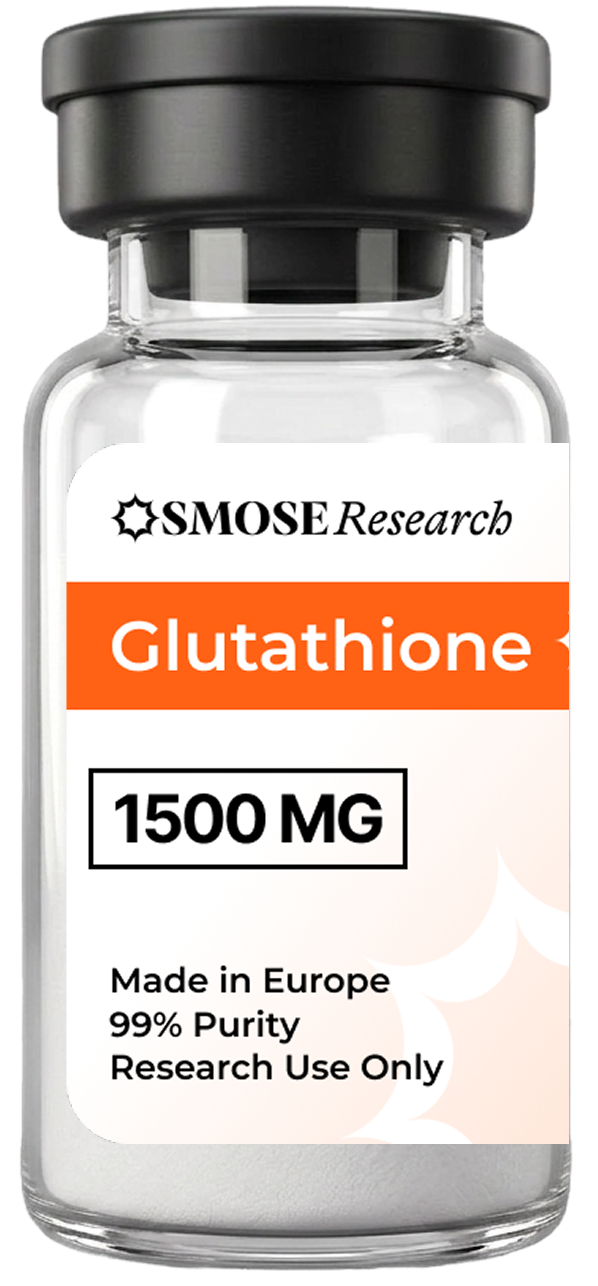
Glutathione
1500 MGGlutathione (GSH / L-glutathione) — γ-Glu-Cys-Gly tripeptide, intracellular antioxidant
Studied therapeutic interests:
Glutathione (GSH, L-glutathione, γ-Glu-Cys-Gly, 307.32 g/mol, CAS 70-18-8) is the main intracellular non-enzymatic antioxidant, present at millimolar concentrations (1-10 mM) in most mammalian cells. Its atypical structure contains a γ-peptide bond between glutamate and cysteine — a bond that protects it from common peptidases and explains its cellular stability. The thiol chain (-SH) of cysteine constitutes the reactive group that scavenges free radicals and electrophiles.
In physiology, GSH maintains cellular redox status by reacting with reactive oxygen species (ROS) to form GSSG (oxidized glutathione disulfide). The GSH/GSSG ratio, typically > 100:1 under physiological conditions, is the reference biomarker of intracellular redox status in oxidative stress research. The regeneration of GSH from GSSG occurs by glutathion reductase (GR, EC 1.8.1.7) NADPH-dependent.
Intracellular synthesis is catalyzed in two ATP-dependent steps by γ-glutamylcysteine synthetase (γ-GCS, limiting step) then glutathione synthetase. Inhibitors such as BSO (L-buthionine sulfoximine) allow preclinical studies on the role of GSH in response to oxidative stress.
In research, GSH is used to study: antioxidant and detoxification response, protein S-glutathionylation (reversible post-translational modification), conjugation with xenobiotics via glutathione S-transferases (GST), and intracellular redox signaling. Cellular models subjected to H₂O₂, paraquat or BSO are classical for inducing GSH depletion.
At OSMOSE Research, L-glutathione is supplied as a lyophilized powder with HPLC purity ≥ 99.2%, accompanied by a complete certificate of analysis.
- Preclinical research on oxidative stress and ROS neutralization
- Studies on GSH/GSSG ratio as redox biomarker
- Research on detoxification by GSH S-transferases (GST)
- Preclinical models of neurodegeneration (Parkinson, Alzheimer)
- Studies on S-glutathionylation of regulatory proteins
- Research on cellular senescence and aging
- Preclinical models of hepatic toxicity (paracetamol, paraquat)
- Studies on the GSH/NADPH/GR redox system
Glutathione is a central molecule in research on oxidative stress and cellular detoxification. The foundational work of Meister, Anderson, Lu and Dalle-Donne (1983-present) established the GSH metabolism, GSH/GSSG redox regulation and redox signaling via S-glutathionylation. Research topics include: calculation of redox potential by Nernst equation, regulation of γ-GCS and GSH synthesis, S-glutathionylation of regulatory proteins (PTP1B, NF-κB p50, SERCA), conjugation with xenobiotics via glutathione S-transferases (GST), and age-related decrease of GSH in neurodegeneration (Parkinson, Alzheimer) and NAFLD. Cellular models induced by H₂O₂ (50-200 µM), paraquat (100-500 µM) or BSO (γ-GCS inhibitor) are classical for depleting GSH and studying responses.
- HPLC purity ≥ 99.2% verified by RP-HPLC
- Molecular mass certified by ESI-MS (307.32 g/mol)
- Free thiol content ≥ 98% (Ellman test)
- Endotoxin test < 0.5 EU/mg by LAL method
- Sterility validation
Frequently asked questions
GSH is the reduced (active) form with a free thiol (-SH), while GSSG is the oxidized dimeric form with an intermolecular disulfide bridge. Under physiological conditions, the GSH/GSSG ratio is > 100:1, maintained by NADPH-dependent glutathione reductase.
The atypical γ-peptide bond between Glu and Cys protects GSH from common peptidases and γ-glutamyl transpeptidase (present at the cell surface), allowing stable intracellular retention. This unique structure explains its millimolar persistence (1-10 mM) in most cells.
GSH is present at 1-10 mM depending on the cell type. Hepatocytes have the highest levels (5-10 mM), erythrocytes ~2 mM, and neurons 1-3 mM. These millimolar concentrations make GSH the main intracellular redox buffer.
Partially. Membrane transport is limited by polarity (two negative charges and one polar thiol). To elevate intracellular pools, NAC (N-acetylcysteine, cysteine precursor) or GSH esters (GSH-ethyl ester) are more effective. Direct use of GSH is relevant for extracellular studies (conjugation, enzymatic tests).
Reference methods are RP-HPLC after derivatization with iodoacetate and FDNB, HPLC-fluorescence with OPA (o-phthalaldehyde), LC-MS/MS mass spectrometry (most precise), and Tietze enzymatic assay with glutathione reductase-DTNB recycling. Rapid extraction on acidic medium (5% perchloric acid) is essential to avoid artifactual oxidation.
The GSH/GSSG couple's standard redox potential is -240 mV at pH 7. Typical cellular potential (calculated by Nernst equation) is -230 to -250 mV. Oxidation to -200 mV signals proliferation or moderate stress, to -170 mV apoptosis.
S-glutathionylation is the reversible post-translational modification of protein cysteines by the formation of a disulfide bond with GSH. It regulates the activity of enzymes and regulatory proteins (PTP1B, NF-κB p50, SERCA) in response to redox stress, acting as a regulatory signal.
Lyophilized GSH dissolves rapidly in sterile water or PBS, but at neutral or alkaline pH it oxidizes spontaneously to GSSG. For maximum stability, prepare solutions in acidic medium (pH 4-6) under nitrogen atmosphere, stable 24h at 4 °C. For prolonged storage, reconstitute extemporaneously.
Classical models include cells exposed to H₂O₂ (50-200 µM), paraquat (100-500 µM), diamide (0.5-2 mM) or BSO (γ-GCS inhibitor) to deplete GSH. Models include IMR-90 (senescence), primary hepatocytes (NAFLD), SH-SY5Y neurons (Parkinson) and cardiomyocytes (ischemia).
Purity ≥ 99.2% HPLC is imperative with verification of free thiol content ≥ 98% by Ellman test (DTNB, absorbance at 412 nm). Synthesis or degradation impurities may include GSSG (oxidation), N-formyl-GSH and cyclized forms, which can alter quantitative measurements.
Complete your research
Often ordered together by our researchers
All products on this page are intended exclusively for in vitro scientific research and laboratory use. They are not intended for human or animal consumption, nor for diagnostic or therapeutic use. The buyer assumes full responsibility for compliance with applicable local regulations.