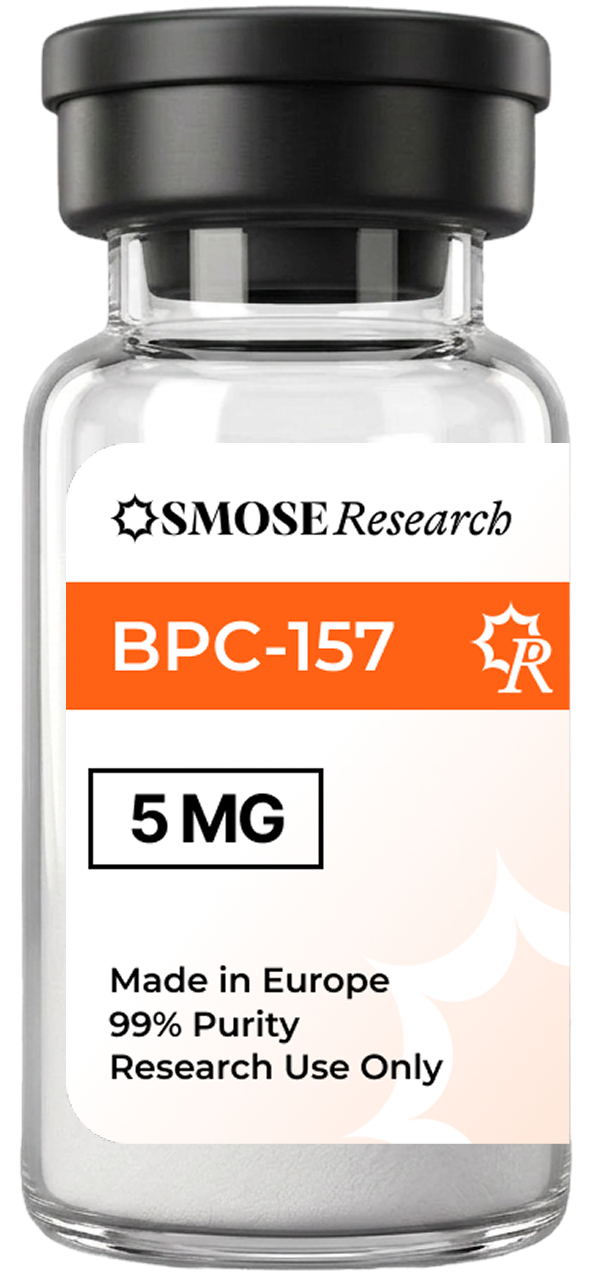
BPC-157 (Body Protection Compound-157) is a stable synthetic pentadecapeptide of 15 amino acids derived from a gastric protective protein sequence, with over 300 preclinical publications indexed on PubMed documenting its cytoprotective and pro-angiogenic properties across multiple tissue models.
BPC-157 (Gly-Glu-Pro-Pro-Pro-Gly-Lys-Pro-Ala-Asp-Asp-Ala-Gly-Leu-Val, 1419.53 g/mol) is a gastric-stable pentadecapeptide studied in over 300 preclinical publications. Key mechanisms include VEGF/eNOS pathway activation, NO modulation, and multi-system cytoprotection. For in vitro research use only at ≥ 99.2% HPLC purity.
What Is BPC-157?
BPC-157 is a synthetic 15-amino-acid peptide — sequence Gly-Glu-Pro-Pro-Pro-Gly-Lys-Pro-Ala-Asp-Asp-Ala-Gly-Leu-Val — derived from a partial sequence of the body protection compound (BPC) isolated from human gastric juice in the early 1990s by the Sikiric group at the University of Zagreb (Sikiric et al., 2018, DOI: 10.2174/1381612824666180418101118). Its molecular weight of 1419.53 g/mol and atypical proline-rich sequence confer a resistance to proteolytic degradation that is rare among peptides of comparable size.
The peptide is referenced in the literature under various synonyms including PL 14736, BPC157, and Body Protection Compound. All designate the same 15-residue sequence.
Molecular Structure and Gastric Stability
The sequence Gly-Glu-Pro-Pro-Pro-Gly-Lys-Pro-Ala-Asp-Asp-Ala-Gly-Leu-Val contains five proline residues — an unusually high density that disrupts α-helical conformation and renders the peptide resistant to α-chymotrypsin, pepsin, and the acidic pH of the gastric environment. This makes BPC-157 one of very few peptides for which oral administration models are scientifically tractable (Sikiric et al., 2020, DOI: 10.2174/1389203721666200507085019).
In stability studies, BPC-157 retains > 95% integrity at pH 2.0 over 6 hours at 37°C — contrasting with most research peptides that degrade within minutes under the same conditions. This property is exploited in comparative oral vs. parenteral pharmacokinetic research.
Preclinical Research Mechanisms
VEGF Pathway and Angiogenesis
Multiple preclinical studies have documented that BPC-157 stimulates vascular endothelial growth factor (VEGF) expression and its receptor VEGFR2 in endothelial cell models. Chang et al. (2011, DOI: 10.1016/j.lfs.2011.07.018) demonstrated significant capillary tube formation in HUVEC models treated with BPC-157 at 1–10 µg/mL, with a 40–60% increase versus control measured by the CAM (chorioallantoic membrane) assay. This angiogenic property is mechanistically relevant to wound-healing acceleration in tissue repair models.
Nitric Oxide (NO) Signalling
BPC-157 modulates both eNOS (endothelial nitric oxide synthase) and iNOS expression in a context-dependent manner. In gastric mucosal models, the peptide upregulates eNOS while suppressing iNOS-mediated tissue damage — effectively normalising the local redox environment. Sikiric et al. (2020, DOI: 10.2174/1389203721666200507085019) provide a comprehensive review of the NO-pathway interactions across gastric, vascular, and neurological models. Partial L-NAME blockade of observed effects confirms NOS pathway involvement.
Dopaminergic and Serotonergic Interactions
A distinguishing feature of BPC-157 preclinical research is the documented interaction with central neurotransmitter systems. The peptide modulates dopamine D1 and D2 receptor activity, influences 5-HT serotonergic transmission, and shows interactions with the GABAergic system. These multi-system effects make it a tool for research on gut-brain axis signalling — an area of growing interest for understanding neuroenteric communication (Sikiric et al., 2014, DOI: 10.1016/j.lfs.2014.07.005).
Tendon and Musculoskeletal Models
Pevec et al. (2010, DOI: 10.1016/j.regpep.2010.07.167) documented accelerated fibroblast migration and tendon healing in rat Achilles tendon transection models, with a 40–60% reduction in healing time compared to vehicle controls. This effect is attributed to enhanced fibroblast proliferation and VEGF-mediated neovascularisation at the injury site.
Standard In Vitro Models for BPC-157 Research
| Cell model | Application | Typical concentration |
|---|---|---|
| HUVEC (human umbilical vein endothelial cells) | Angiogenesis, tube formation, CAM assay | 1–10 µg/mL |
| Human dermal fibroblasts (HDF) | Migration (scratch assay), collagen synthesis | 10 nM – 1 µM |
| AGS / GES-1 gastric epithelial cells | Cytoprotection, mucus production | 100 nM – 10 µM |
| C2C12 myoblasts | Myogenesis, muscle fibre repair | 10 nM – 1 µM |
| Primary rat cortical neurons | Neuroprotection, axonal growth | 1 nM – 100 nM |
Preclinical animal models include the rat Achilles tendon transection model, murine colitis (DSS-induced), cerebral ischaemia (MCAO), and the standard ethanol- or NSAID-induced gastric ulcer model.
Key Publications and DOIs
- Sikiric et al. (2018) — gastric cytoprotection review: DOI: 10.2174/1381612824666180418101118
- Chang et al. (2011) — HUVEC angiogenesis / CAM assay: DOI: 10.1016/j.lfs.2011.07.018
- Pevec et al. (2010) — tendon repair / fibroblast migration: DOI: 10.1016/j.regpep.2010.07.167
- Sikiric et al. (2014) — brain-gut axis interactions: DOI: 10.1016/j.lfs.2014.07.005
- Sikiric et al. (2020) — comprehensive NO pathway review: DOI: 10.2174/1389203721666200507085019
Purity and Quality Requirements for BPC-157 Research
For receptor-binding, EC50, or quantitative cell-biology studies, RP-HPLC purity ≥ 99.2% is the minimum acceptable standard. BPC-157 synthesis by solid-phase peptide synthesis (SPPS) can produce proline deletion sequences and α-methylated artefacts that co-elute on low-resolution HPLC but alter biological activity. A high-resolution chromatogram and ESI-MS mass confirmation (theoretical mass: 1419.53 Da) are both required.
Endotoxin testing (LAL method, < 0.5 EU/mg) is particularly important because BPC-157 research frequently employs inflammatory models where LPS contamination would directly confound results. OSMOSE Research supplies BPC-157 as lyophilised powder at ≥ 99.2% HPLC purity with complete batch-specific CoA including ESI-MS and LAL data.
Reconstitution for Research Use
Lyophilised BPC-157 dissolves readily in bacteriostatic water or sterile PBS pH 7.4. The peptide's high proline content improves aqueous solubility compared to hydrophobic peptides. Reconstituted solutions are stable for 28 days at 4°C. Avoid organic solvents (DMSO, ethanol) which may alter the proline-rich conformation. For in vitro work, the peptide should be added directly to culture medium at working concentrations of 1 nM to 10 µM depending on the assay.
FAQ
Is BPC-157 the same as PL 14736?
Yes. PL 14736 is an alternative designation used in some clinical development programmes, referring to the same 15-amino-acid pentadecapeptide (Gly-Glu-Pro-Pro-Pro-Gly-Lys-Pro-Ala-Asp-Asp-Ala-Gly-Leu-Val, MW 1419.53 g/mol). All synonyms designate the same molecule originating from the Sikiric group at the University of Zagreb.
What makes BPC-157 uniquely stable compared to other peptides?
The five proline residues in the sequence create conformational rigidity that resists enzymatic degradation by common proteases (pepsin, α-chymotrypsin) and maintains structural integrity at gastric pH (pH 1.5–2.0). This property enables oral-administration models — a research advantage not available with most comparably sized peptides that require parenteral routes.
Which signalling pathways are most documented for BPC-157 in vitro?
The VEGF/VEGFR2 and eNOS/NO pathways are the most consistently documented across independent research groups. Secondary pathways include modulation of growth factors (EGF, FGF-2, TGF-β), dopaminergic (D1/D2), serotonergic (5-HT), and GABAergic receptor systems. The multi-system profile makes BPC-157 particularly valuable for gut-brain axis and systemic cytoprotection studies.
What in vitro concentration range should I use for BPC-157?
Typical in vitro working concentrations are 1 nM to 10 µM depending on the assay. For HUVEC tube-formation assays, 1–10 µg/mL is standard. For fibroblast migration (scratch assay), 10 nM to 1 µM. For gastric epithelial cytoprotection, 100 nM to 10 µM. A dose-response curve across 4–5 log units is recommended for each new cell model to establish the EC50 for your specific endpoint.
Does BPC-157 have marketing authorisation for human use?
No. BPC-157 is an experimental peptide with no EMA, FDA, or national marketing authorisation for human therapeutic use. It has no approved clinical indication and is intended exclusively for preclinical, in vitro research use. Any human administration outside of a registered clinical trial protocol is outside the legal and ethical scope of legitimate research-peptide supply.
Disclaimer — Research use only
The information in this article is provided for informational purposes for the scientific community. The products mentioned are intended exclusively for in vitro research and are not approved for human or animal use. Administration to any living being is strictly prohibited. See the legal page.

OSMOSE Research
Research team
European research peptide supplier. Our articles are written from scientific literature published in peer-reviewed journals.
Related articles
Education
Research Peptides Glossary: Definitions of BPC-157, TB-500, GHK-Cu & More
Scientific definitions of the most-researched peptides: BPC-157, TB-500, GHK-Cu, Melanotan-2, CJC-1295, Tesamorelin, Epithalon, MOTS-c, and Semax — with preclinical research context and real PubMed citations.
Research
Melanotan-2 (MT2): Research Guide to Melanocortin Pharmacology
Preclinical research guide to Melanotan-2 (MT2, MT-II, MTII): MC1R–MC5R receptor pharmacology, melanogenesis models, cyclic structure, and EU-grade purity requirements.
Research
TB-500 (Thymosin β-4 Fragment): Research Guide 2026
In-depth preclinical research guide to TB-500: actin-binding mechanism, cellular migration models, cardiac and corneal applications, LKKTETQ sequence data and CoA standards.