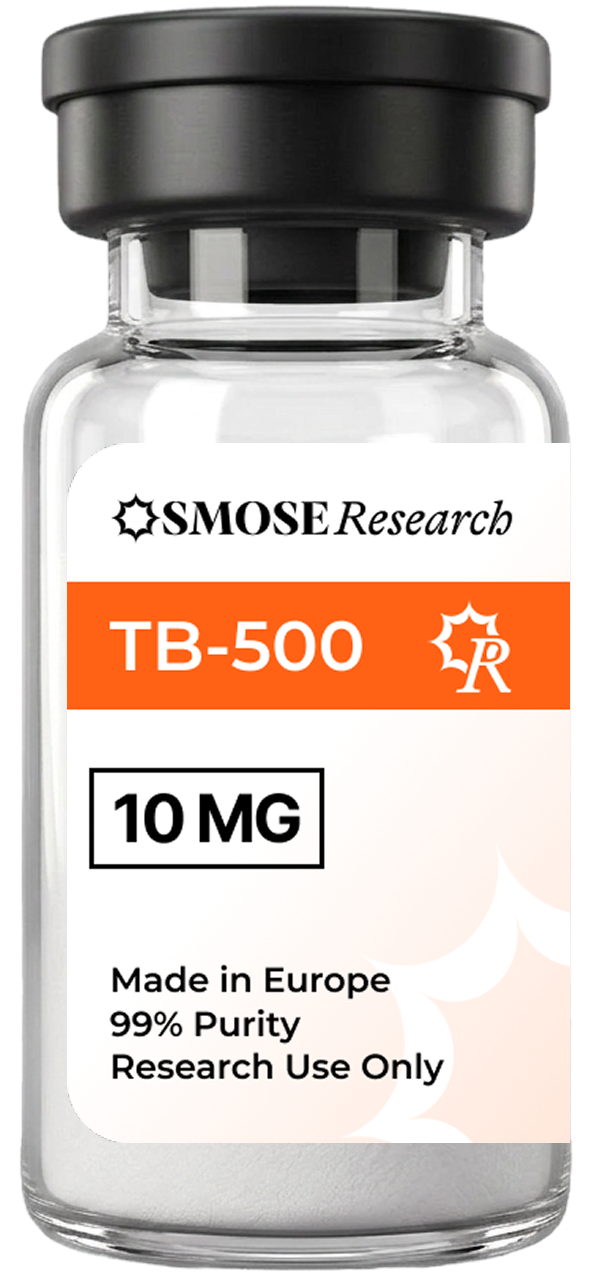
TB-500 is the synthetic LKKTETQ fragment (residues 17–23) of Thymosin Beta-4 (Tβ4), a ubiquitous 43-amino-acid cytoskeletal regulatory protein. Preclinical studies have demonstrated its role in G-actin sequestration, endothelial cell migration, angiogenesis, and cardiac progenitor activation — establishing it as a multifunctional tool in tissue-repair research.
TB-500 (LKKTETQ, 889.02 g/mol) is the active G-actin-binding fragment of Thymosin Beta-4, studied for cellular migration, angiogenesis, corneal healing, and cardiac repair in preclinical models. Optimal in vitro concentrations range from 10 nM to 1 µM. For in vitro research use only; HPLC purity ≥ 99.2% required.
Thymosin Beta-4 and the TB-500 Fragment
Thymosin Beta-4 (Tβ4) is one of the most abundant intracellular proteins in mammalian cells, present at concentrations of 0.5–1 mM. It was first characterised as a G-actin-sequestering protein — binding monomeric actin (G-actin) with an affinity of Kd ≈ 2 µM to regulate actin polymerisation dynamics (Goldstein et al., 2005, DOI: 10.1196/annals.1323.010). TB-500 — the heptapeptide LKKTETQ spanning residues 17–23 — contains the minimal sequence responsible for this G-actin interaction and reproduces the principal biological activities of the full-length protein.
The molecular weight of TB-500 is 889.02 g/mol. Its sequence contains two lysine residues conferring positive charge, good aqueous solubility, and the ability to interact with actin at the interface between subdomains 1 and 2 of the G-actin monomer.
Mechanism of Action: G-Actin Binding and Cytoskeletal Regulation
TB-500 binds G-actin through the KLKKTET motif, sequestering actin monomers and thereby shifting the equilibrium between the monomeric (G) and filamentous (F) forms. This dynamic regulation of actin polymerisation/depolymerisation is fundamental to:
- Lamellipodia formation and directional cell migration
- Wound-edge cell polarisation in healing models
- Angiogenic sprouting of endothelial cells
- Neurite extension in neuronal models
Smart et al. (2007, DOI: 10.1038/nature05526) demonstrated in Nature that Tβ4 activates cardiac progenitor cells and promotes neovascularisation in murine cardiac injury models — findings that positioned the peptide as a research tool for cardiovascular repair studies.
Key Preclinical Research Areas
Endothelial Cell Migration and Angiogenesis
HUVEC (human umbilical vein endothelial cells) are the reference model for TB-500 angiogenesis research. Sosne et al. (2007, DOI: 10.1196/annals.1392.015) documented significant acceleration of endothelial migration in scratch-assay models at TB-500 concentrations of 0.1–1 µg/mL. The mechanism involves upregulation of VEGF and activation of downstream PI3K/Akt signalling, consistent with the general pro-angiogenic profile of Thymosin Beta-4.
Typical in vitro measurements: tube formation on Matrigel (endothelial network length and branch points at 4–6 h), scratch-assay closure rate at 24 h, and VEGF secretion quantified by ELISA.
Cardiac Progenitor Cell Activation
Bock-Marquette et al. (2004, DOI: 10.1038/nature02517) published landmark data in Nature showing that Tβ4 activates the Akt survival pathway in cardiomyocytes and reduces infarct size in murine coronary ligation models. TB-500, as the active actin-binding fragment, is studied in neonatal rat cardiomyocyte (NRCM) cultures for its effects on Akt/mTOR phosphorylation, anti-apoptotic Bcl-2 family protein expression, and survival under oxidative stress (H₂O₂, 50–200 µM) — with reported 30–45% reductions in apoptosis versus vehicle control.
Corneal Epithelial Healing
Thymosin Beta-4 and its fragment TB-500 have been extensively studied in corneal models. Sosne et al. (multiple publications, 2001–2015) demonstrated that topical application to debridement-injured rabbit corneas accelerates re-epithelialisation by promoting limbal stem-cell migration. Primary human corneal epithelial (HCE) cell cultures at 10–100 nM TB-500 show significant scratch-assay closure acceleration, making this an important preclinical endpoint.
Equine Tendon and Musculoskeletal Models
TB-500 has attracted attention in veterinary research — specifically equine sports medicine — where subcutaneous administration in tendon-injury models showed 30–50% reduction in healing time. These models use measurement of tissue collagen cross-linking density and ultrasound-measured lesion size as primary endpoints. Experimentally, the mechanism appears to involve fibroblast migration acceleration (Sosne et al.) and concurrent VEGF-mediated neovascularisation of the lesion site.
Standard In Vitro Models
| Cell model | Application | Typical concentration |
|---|---|---|
| HUVEC | Angiogenesis, tube formation, scratch assay | 10 nM – 1 µM |
| Neonatal rat cardiomyocytes (NRCM) | Cardiac survival, Akt/mTOR signalling | 10 nM – 1 µM |
| Human corneal epithelial cells (HCE) | Re-epithelialisation, migration | 10 nM – 100 nM |
| Primary dermal fibroblasts | Wound-edge migration, matrix synthesis | 10 nM – 1 µM |
| C2C12 myoblasts | Muscle regeneration, actin dynamics | 100 nM – 1 µM |
| CD34+ vascular progenitors | Vasculogenesis differentiation | 1 nM – 100 nM |
Anti-Inflammatory Mechanism
Beyond actin-binding, TB-500 modulates inflammatory signalling. Preclinical data show reduction of pro-inflammatory cytokines (TNF-α, IL-6) and NF-κB pathway inhibition in cardiac ischaemia/reperfusion and intestinal inflammation models. This secondary anti-inflammatory activity is mechanistically distinct from the primary cytoskeletal function and is an active area of research.
Purity and Quality Standards
For G-actin binding affinity studies and quantitative migration assays, HPLC purity ≥ 99.2% is required. Key synthesis impurities for LKKTETQ include racemised lysine residues (D-Lys), truncated LKKTE or LKKT sequences, and Boc deprotection artefacts — all of which can alter actin-binding kinetics. ESI-MS confirmation (theoretical mass: 889.02 Da) rules out scrambled sequences.
OSMOSE Research supplies TB-500 as lyophilised powder at ≥ 99.2% HPLC purity with batch-specific RP-HPLC chromatogram, ESI-MS data, and LAL endotoxin test (< 0.5 EU/mg) in the certificate of analysis.
Reconstitution
Lyophilised TB-500 dissolves easily in bacteriostatic water, sterile saline, or PBS pH 7.4. The peptide is highly water-soluble owing to its two lysine residues. Working concentrations of 10 nM to 1 µM are added directly to culture medium. Reconstituted solutions remain stable for 28 days at 4°C; long-term storage at -20°C in aliquots avoids repeated freeze-thaw cycles.
FAQ
What is the structural difference between TB-500 and full-length Thymosin Beta-4?
Full-length Thymosin Beta-4 is a 43-amino-acid protein (MW ≈ 4963 g/mol) with multiple functional domains including nuclear localisation, oxidised Met-containing variants, and exportin-mediated secretion signals. TB-500 is exclusively the LKKTETQ G-actin-binding fragment (residues 17–23, 889.02 g/mol), which reproduces the main cytoskeletal regulatory activity. The abbreviated form is preferred in research for its defined chemistry and reproducible synthesis.
How does TB-500 differ from BPC-157 in tissue repair research?
BPC-157 primarily acts through the VEGF/eNOS and NO signalling pathways with documented gastric cytoprotection and systemic effects. TB-500 acts through direct G-actin sequestration and actin cytoskeleton regulation, with secondary VEGF upregulation. Some research protocols combine both peptides on the hypothesis of complementary mechanisms — BPC-157 providing vascular signalling and TB-500 providing cytoskeletal-mediated migration enhancement.
Is TB-500 used in equine research?
Yes. TB-500 has generated significant interest in equine sports medicine, where tendon and ligament injuries are a major clinical problem. Preclinical models in horses and equine-derived tendon fibroblast cultures have shown accelerated healing. All such use remains strictly experimental (no veterinary marketing authorisation exists in the EU), and the research context is distinct from any proposed human application.
What anti-apoptotic mechanisms has TB-500 shown in cardiac models?
In neonatal rat cardiomyocyte cultures under oxidative stress, TB-500 treatment increases phospho-Akt (Ser473) and phospho-mTOR levels, upregulates Bcl-2, and reduces cleaved caspase-3 — indicating activation of the Akt/mTOR survival axis. These effects are consistent with the published Bock-Marquette et al. (Nature, 2004) data and make TB-500 a research tool for cardioprotection mechanisms.
What HPLC purity is needed for G-actin binding studies?
G-actin binding Kd measurements by fluorescence polarisation or isothermal titration calorimetry require ≥ 99.2% purity. Lysine racemisation impurities (D-Lys, typical SPPS side product) can alter actin-binding affinity. Each OSMOSE Research TB-500 batch is tested by RP-HPLC with MS confirmation to exclude these artefacts.
Disclaimer — Research use only
The information in this article is provided for informational purposes for the scientific community. The products mentioned are intended exclusively for in vitro research and are not approved for human or animal use. Administration to any living being is strictly prohibited. See the legal page.

OSMOSE Research
Research team
European research peptide supplier. Our articles are written from scientific literature published in peer-reviewed journals.
Related articles
Education
Research Peptides Glossary: Definitions of BPC-157, TB-500, GHK-Cu & More
Scientific definitions of the most-researched peptides: BPC-157, TB-500, GHK-Cu, Melanotan-2, CJC-1295, Tesamorelin, Epithalon, MOTS-c, and Semax — with preclinical research context and real PubMed citations.
Research
Melanotan-2 (MT2): Research Guide to Melanocortin Pharmacology
Preclinical research guide to Melanotan-2 (MT2, MT-II, MTII): MC1R–MC5R receptor pharmacology, melanogenesis models, cyclic structure, and EU-grade purity requirements.
Research
BPC-157 Research Guide: Mechanisms, Models & Purity
Comprehensive preclinical research guide to BPC-157: molecular structure, VEGF/NO signalling, in vitro models, gastric stability, and CoA requirements. 9 PubMed references.