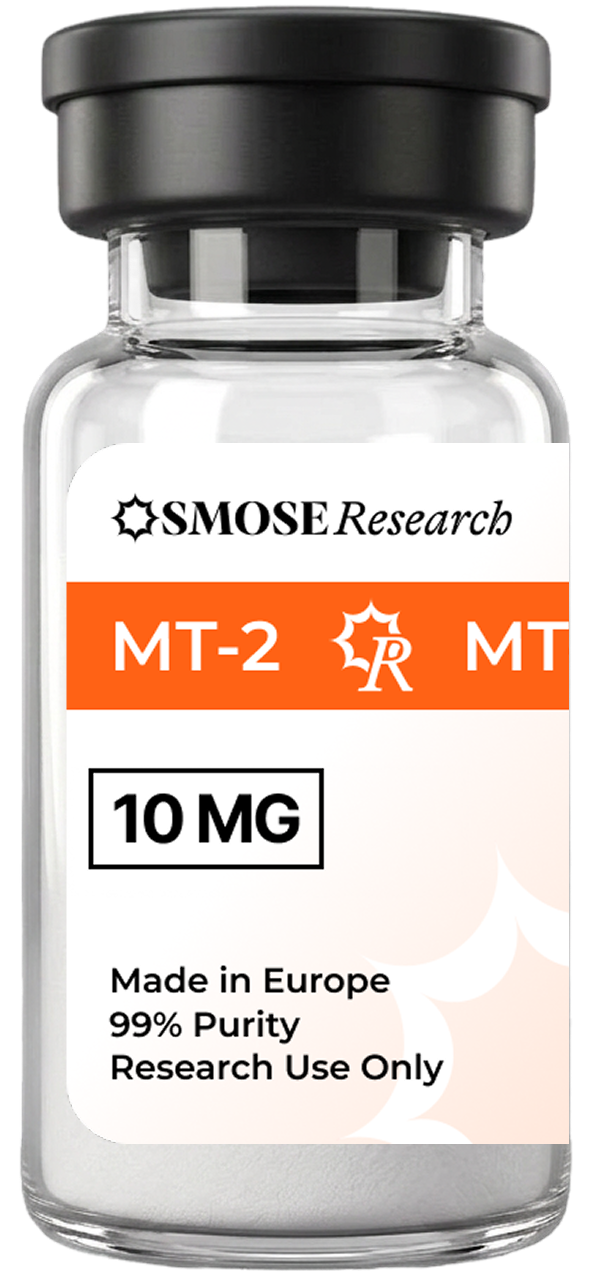
Melanotan-2 (MT2, MT-II, MTII) is a synthetic cyclic heptapeptide — Ac-Nle-cyclo[Asp-His-D-Phe-Arg-Trp-Lys]-NH₂, MW 1024.18 g/mol — developed at the University of Arizona as a superagonist analogue of α-MSH. Its non-selective activity across MC1R through MC5R, sub-nanomolar affinity for MC4R, and exceptional metabolic stability make it the reference pharmacological tool for melanocortin receptor research in preclinical in vitro settings.
Melanotan-2 (MT-II, MTII) is a cyclic α-MSH superagonist with sub-nanomolar affinity for MC4R (EC50 ~0.1 nM) and nanomolar activity at MC1R, MC3R, and MC5R. The lactam bridge between Asp² and Lys⁷ rigidifies the His-Phe-Arg-Trp pharmacophore, conferring exceptional protease resistance. Reference models: B16-F10 melanocytes (MC1R), HEK-293/hMC4R (central studies). For in vitro research use only.
Structural Features of MT-II
MT-II is a heptapeptide with a lactam bridge between the aspartic acid at position 2 and the lysine at position 7, creating a cyclic ring structure that rigidifies the His-Phe-Arg-Trp pharmacophore — the tetrapeptide motif shared with α-MSH, β-MSH, and γ-MSH that drives melanocortin receptor activation. Two additional modifications distinguish MT-II from native α-MSH:
- D-Phenylalanine at position 7 (in place of natural L-Phe): D-amino acids resist exopeptidase cleavage, substantially extending in vivo half-life from < 10 minutes (α-MSH) to ~1 hour.
- Norleucine (Nle) at position 4 (replacing Met): eliminates the methionine oxidation vulnerability, improving chemical stability during synthesis and storage.
These modifications were rationally designed by Hadley and Hruby at the University of Arizona (Hadley and Dorr, 2006, DOI: 10.1016/j.peptides.2005.10.022) based on structure-activity relationships of the melanocortin pharmacophore.
Receptor Pharmacology: MC1R Through MC5R
Chen et al. (1997, DOI: 10.1074/jbc.272.2.1265) characterised MT-II affinity across all four melanocortin receptor subtypes expressed in HEK-293 cells, establishing the following EC50 values for cAMP accumulation:
| Receptor | MT-II EC50 | Primary biological context |
|---|---|---|
| MC1R | ~0.21 nM | Melanogenesis, skin pigmentation |
| MC3R | ~0.5 nM | Energy balance, behaviour |
| MC4R | ~0.33 nM | Central food intake regulation |
| MC5R | ~5 nM | Exocrine gland secretion |
This non-selective superagonist profile distinguishes MT-II from afamelanotide (NDP-α-MSH), which is a predominantly MC1R-selective agonist with an MA in Europe (Scenesse® for erythropoietic protoporphyria, EPP). Comparative studies using MT-II alongside the antagonist SHU-9119 and the endogenous antagonist AgRP allow dissection of receptor-specific contributions to observed effects.
Melanogenesis Research: B16-F10 and MNT-1 Models
The most extensively published in vitro model for MT-II-driven melanogenesis is the B16-F10 murine melanocyte line. Abdel-Malek et al. (2001, DOI: 10.1096/fj.00-0502fje) demonstrated that MT-II stimulation at 1–100 nM for 24–72 h produces dose-dependent increases in:
- Tyrosinase (TYR) activity: the rate-limiting enzyme of eumelanin synthesis, measured colorimetrically via DOPA oxidation
- TRP-1 and TRP-2 (TYRP1/DCT) expression: enzymes completing the melanin biosynthetic pathway
- MITF (microphthalmia-associated transcription factor): the master regulator transcription factor
- Total melanin content: measured by NaOH solubilisation and spectrophotometry at 405 nm
The cAMP/PKA/CREB/MITF signalling cascade is the primary mediator: MT-II → MC1R → Gαs → adenylyl cyclase → cAMP ↑ → PKA → CREB phosphorylation → MITF transcription → TYR/TYRP1/TYRP2 expression.
Human melanocyte lines MNT-1 and primary isolated human melanocytes (HEM) are used for translational relevance, with similar MC1R-mediated responses at comparable concentrations.
Central Studies: MC4R and Energy Homeostasis
MT-II is extensively used in hypothalamic models to study central regulation of food intake and energy expenditure via MC4R. The foundational work of Fan et al. (1997, DOI: 10.1038/385165a0, Nature) established the conceptual framework: intracerebroventricular (ICV) injection of MT-II in ob/ob mice reduces food intake and activates energy expenditure, effects blocked by the MC3R/MC4R antagonist SHU-9119. This established the central melanocortin system as a key leptin-downstream pathway.
In vitro models for this research area use GT1-7 hypothalamic neuronal cells expressing MC4R, or HEK-293 cells recombinantly expressing human MC4R (hMC4R), with cAMP accumulation as the primary readout (HTRF or ELISA). MT-II at 0.1–1 nM is sufficient to produce maximal cAMP responses in hMC4R-expressing cells.
Comparative Pharmacology Studies
MT-II's research value is amplified by its use as a reference comparator:
- vs. Afamelanotide (NDP-α-MSH): MC1R selectivity vs. non-selective superagonism — compare melanogenesis per unit of receptor activation
- vs. α-MSH: same pharmacophore, cyclic vs. linear — compare metabolic stability and receptor kinetics
- vs. SHU-9119: MT-II is an agonist; SHU-9119 is a mixed MC3R/MC4R antagonist — used to confirm receptor specificity
- vs. AgRP: endogenous inverse agonist at MC3R/MC4R — competitive displacement studies
Purity and Quality Requirements
The cyclic lactam structure of MT-II introduces specific synthesis quality-control requirements. The critical impurity to exclude is the linear (non-cyclised) form (MW 1042.19 Da = cyclic form +18 Da, corresponding to one water molecule). This impurity is inactive but co-elutes with the active cyclic form on low-resolution RP-HPLC columns, requiring high-resolution methods and ESI-MS confirmation of the exact mass (1024.18 Da). Tryptophan oxidation products (Trp → Trp-ox, +16 Da) are also common synthesis artefacts detectable by MS.
OSMOSE Research supplies Melanotan-2 at ≥ 99.2% HPLC purity with ESI-MS confirmation of the cyclic structure (1024.18 Da), LAL endotoxin test (< 0.5 EU/mg), and cyclisation verification in the CoA.
Reconstitution
MT-II reconstitutes in bacteriostatic water or PBS pH 7.4 at > 1 mg/mL. The cyclic structure provides good aqueous solubility (charged residues Asp, His, Arg, Lys assist). Avoid vigorous vortexing that can cause peptide aggregation. Stock concentration typically 10 mg/mL; working concentrations 0.01–100 nM for receptor studies, 1–100 nM for melanogenesis models. Stable 28 days at 4°C; store aliquots at -20°C.
FAQ
Are MT2, MT-II, MTII, and Melanotan II identical?
Yes. MT2, MT-II, MTII, MT-2, and Melanotan II are all abbreviations for the same molecule: Ac-Nle-cyclo[Asp-His-D-Phe-Arg-Trp-Lys]-NH₂ (MW 1024.18 g/mol). The different spellings reflect varying journal and laboratory nomenclature conventions and do not indicate different chemical entities.
How does MT-II differ from Melanotan-1 (afamelanotide)?
Afamelanotide (NDP-α-MSH, Scenesse®) is a 13-residue linear α-MSH analogue with selective MC1R affinity used in EPP treatment. MT-II is a 7-residue cyclic superagonist with potent activity at all four melanocortin receptors, particularly MC4R. MT-II is the preferred tool for central and multi-receptor studies; afamelanotide is preferred for peripheral MC1R-focused melanogenesis research.
Why is D-Phe important in MT-II's structure?
D-Phenylalanine (D-Phe) at position 7 of MT-II rigidifies the bioactive conformation of the His-Phe-Arg-Trp pharmacophore and simultaneously blocks C-terminal exopeptidase cleavage. This dual function — conformational preorganisation for high receptor affinity, plus protease resistance for extended research window — was the primary rationale for its inclusion in the Hadley/Hruby design.
Which in vitro model should I use to study MC4R?
The standard models for MC4R are HEK-293 cells stably or transiently expressing human MC4R (hMC4R), with cAMP accumulation measured by HTRF or ELISA as the primary readout. GT1-7 hypothalamic neuronal cells endogenously express MC4R and are used when a more physiologically relevant neuronal context is required. MT-II at 0.1–1 nM produces near-maximal cAMP responses in both models.
Does MT-II have any marketing authorisation in Europe?
No. Melanotan-2 (MT-II) has no EMA or national marketing authorisation for any therapeutic indication in Europe or worldwide. The only authorised melanocortin analogue in Europe is afamelanotide (Scenesse®) for erythropoietic protoporphyria. MT-II is exclusively for in vitro preclinical research use. ANSM and EMA have issued warnings against its use outside of authorised clinical research.
Disclaimer — Research use only
The information in this article is provided for informational purposes for the scientific community. The products mentioned are intended exclusively for in vitro research and are not approved for human or animal use. Administration to any living being is strictly prohibited. See the legal page.

OSMOSE Research
Research team
European research peptide supplier. Our articles are written from scientific literature published in peer-reviewed journals.
Related articles
Education
Research Peptides Glossary: Definitions of BPC-157, TB-500, GHK-Cu & More
Scientific definitions of the most-researched peptides: BPC-157, TB-500, GHK-Cu, Melanotan-2, CJC-1295, Tesamorelin, Epithalon, MOTS-c, and Semax — with preclinical research context and real PubMed citations.
Research
TB-500 (Thymosin β-4 Fragment): Research Guide 2026
In-depth preclinical research guide to TB-500: actin-binding mechanism, cellular migration models, cardiac and corneal applications, LKKTETQ sequence data and CoA standards.
Research
BPC-157 Research Guide: Mechanisms, Models & Purity
Comprehensive preclinical research guide to BPC-157: molecular structure, VEGF/NO signalling, in vitro models, gastric stability, and CoA requirements. 9 PubMed references.