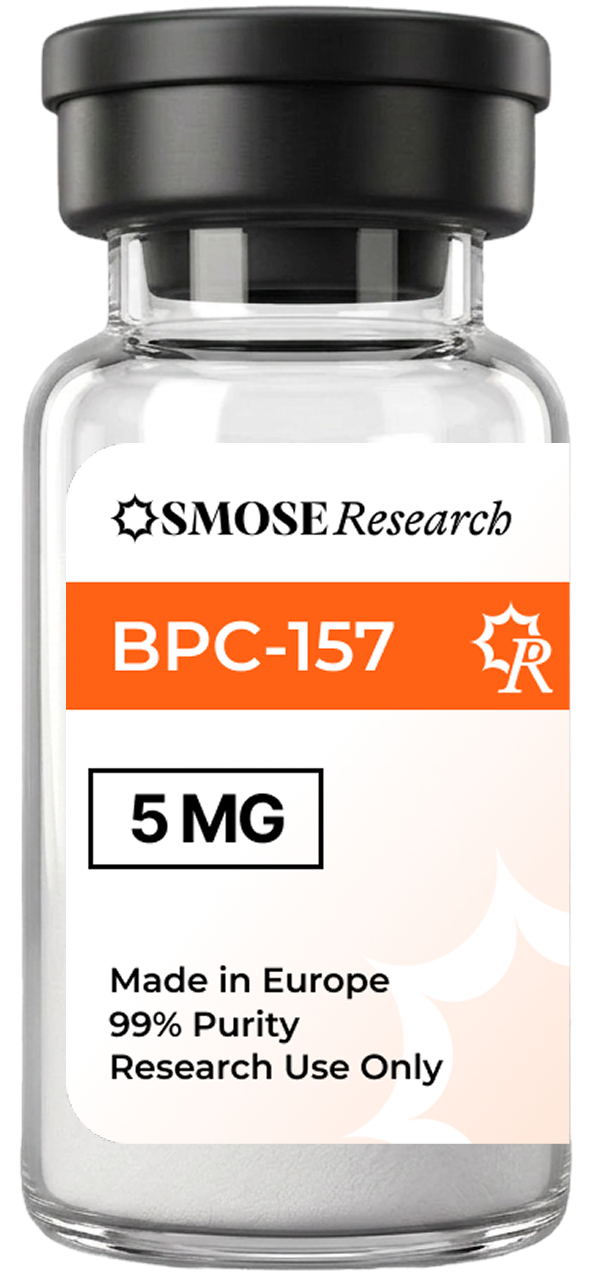
BPC-157
5 MGBPC-157 — 15-amino-acid pentadecapeptide for research on cytoprotection
Studied therapeutic interests:
Choose quantity
BPC-157 (Body Protection Compound-157) is a synthetic pentadecapeptide composed of 15 amino acids (Gly-Glu-Pro-Pro-Pro-Gly-Lys-Pro-Ala-Asp-Asp-Ala-Gly-Leu-Val), derived from a partial sequence of a gastric protective protein discovered in human gastric juice in the early 1990s by the Sikiric group (University of Zagreb).
This peptide has generated significant research interest in gastroenterology, musculoskeletal and systemic healing fields due to its demonstrated effects in numerous preclinical models. Studies show that BPC-157 modulates multiple signaling pathways involved in cellular repair, including the VEGF pathway, nitric oxide (NO) signaling, and interactions with the dopaminergic, serotonergic and GABAergic systems.
Preclinical research has documented acceleration of tendon, ligament, muscle and nerve healing, as well as cytoprotective effects on gastrointestinal, vascular and cardiac tissues. A notable feature is its oral and parenteral stability — gastric acids do not hydrolyze the pentadecapeptide, a rare property for a therapeutic peptide.
At OSMOSE Research, BPC-157 is supplied as a lyophilized powder with HPLC purity ≥ 99.2%, accompanied by a comprehensive certificate of analysis. Manufactured in Europe under GMP standards, this research peptide is delivered to France, Belgium, Switzerland, Luxembourg and worldwide internationally within 24-48 hours.
- Preclinical studies on tissue healing
- Angiogenesis and neovascularization research
- Models of cytoprotection of the gastric mucosa
- Studies on tendon and ligament repair
- Peripheral nerve regeneration research
- Models of intestinal inflammation and dysbiosis
- Studies on the protective effects of NSAIDs on the gastric mucosa
- Research on central nervous system effects
BPC-157 is one of the most extensively studied research peptides for its effects on healing. Dozens of preclinical studies by the Sikiric group (University of Zagreb) have documented accelerated tendon healing (40-60%), protection against gastrointestinal ulcers, and interactions with the nitric oxide (NO) pathway. Research topics include: the vascular repair VEGF/eNOS pathway, inhibition of the toxic effects of NSAIDs on gastric mucosa, modulation of gut microbiota, and central effects in models of depression and anxiety. The unique oral stability of the pentadecapeptide makes it a valuable research tool for comparative studies.
- HPLC purity ≥ 99.2% verified by RP-HPLC
- Molecular mass certified by ESI-MS
- Endotoxin test < 0.5 EU/mg by LAL
- Sterility validation
Frequently asked questions
BPC-157 is derived from a partial sequence of a gastric protective protein discovered in human gastric juice in the early 1990s by the group of Predrag Sikiric at the University of Zagreb in Croatia. The synthetic peptide contains 15 specific amino acids.
The specific amino-acid sequence of BPC-157 contains multiple prolines that confer resistance to digestive enzymes and acidic pH. This stability, rare among peptides, allows for oral administration research — unlike most peptides that require parenteral routes.
Preclinical studies use diverse models: rodent tendon injury, experimental gastric ulcers (induced by NSAIDs or alcohol), peripheral nerve injuries, colitis, myocardial infarction and cerebral ischemia. These models allow broad characterization of observed cytoprotective effects.
Lyophilized BPC-157 dissolves easily in bacteriostatic water, sterile saline or PBS buffer. Typical in vitro concentrations range from 1 nM to 10 µM. Once reconstituted, the solution remains stable for 28 days at 4 °C.
Preclinical research has documented interactions with several pathways: VEGF (angiogenesis), endothelial nitric oxide (eNOS), dopaminergic system (D1, D2), serotonergic (5-HT), and modulation of GABAergic receptors. These multiple interactions explain the diversity of observed effects.
No. BPC-157 is an experimental peptide intended exclusively for in vitro research. It does not hold an MA (ANSM, EMA, FDA) and cannot be administered to humans outside of registered clinical protocols.
Each batch of BPC-157 undergoes RP-HPLC analysis with UV detection to verify purity ≥ 99.2%. Mass is confirmed by ESI-MS mass spectrometry. These analyses are included in the certificate of analysis (CoA) delivered with the batch.
Yes, PL 14736 is an alternative designation for BPC-157 found in some research publications. It refers to the same 15-amino-acid pentadecapeptide with identical pharmacological properties.
Research shows that BPC-157 stimulates the formation of new blood vessels (angiogenesis) via the VEGF pathway in preclinical models. This property is relevant for studying tissue repair, where neovascularization is a crucial step of the healing process.
Yes, BPC-157 is widely used in primary cell cultures (fibroblasts, endothelial cells, myoblasts) and established lines (HUVEC, C2C12, HT-29) to study signaling pathways and cellular repair mechanisms. Typical concentrations are 10 nM to 1 µM.
Complete your research
Often ordered together by our researchers
All products on this page are intended exclusively for in vitro scientific research and laboratory use. They are not intended for human or animal consumption, nor for diagnostic or therapeutic use. The buyer assumes full responsibility for compliance with applicable local regulations.