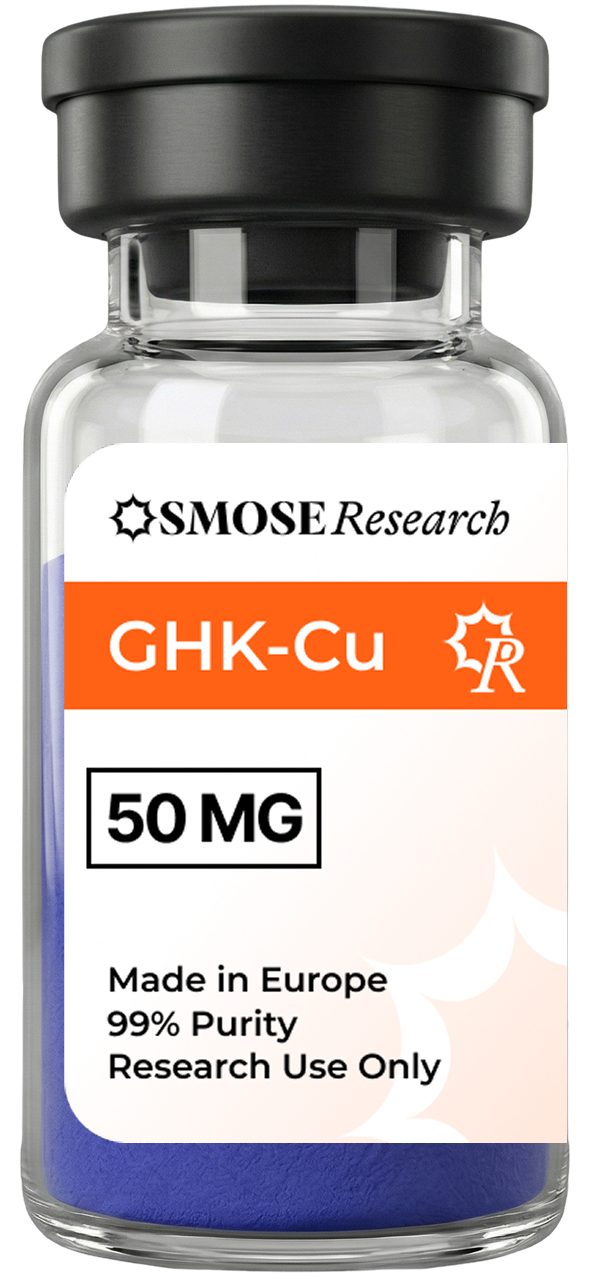
GHK-Cu
50 MGCopper tripeptide GHK-Cu — research on tissue repair and anti-aging
Studied therapeutic interests:
Choose quantity
GHK-Cu (Gly-His-Lys-Cu²⁺) is a naturally occurring copper-binding tripeptide, identified in 1973 by Pickart and Thaler in human plasma. Its concentration declines with age — from approximately 200 ng/mL at age 20 to 80 ng/mL at age 60 — raising interest in its role in tissue regeneration pathways.
The bioactive complex consists of the GHK peptide and a copper(II) ion coordinated through the imidazole ring of histidine, the α-amino group of glycine and the backbone. This square-planar coordination geometry delivers copper to mitochondria, lysyl oxidase and superoxide dismutase — three key enzymatic systems.
Preclinical studies have shown that GHK-Cu modulates the expression of over 4,000 genes in human fibroblasts, including those involved in wound healing, extracellular matrix synthesis and antioxidant response. In vivo, wound-healing acceleration by GHK-Cu has been documented in murine, rat and rabbit models.
At OSMOSE Research, GHK-Cu is supplied as a lyophilized powder with HPLC purity ≥ 99.2%, complete with certificate of analysis. Manufactured in Europe under GMP standards, this research peptide is delivered under controlled temperature to France, Belgium and Switzerland.
- In vitro wound-healing research and tissue regeneration
- Collagen types I/III synthesis studies in human fibroblasts
- Dermal extracellular matrix remodeling research
- Preclinical hair-growth studies
- Cellular anti-aging research
- Stem-cell differentiation research
- In vitro mitochondrial biogenesis studies
- Cosmetic peptide formulation research
GHK-Cu is one of the most extensively studied copper peptides in dermatological and regenerative research. The foundational work of Pickart (1973-present) established that this tripeptide binds Cu²⁺ with high affinity (log K ≈ 16.44) and modulates the expression of over 4,000 human genes. Research topics include: upregulation of types I and III collagen in human fibroblasts, activation of matrix metalloproteinases and their inhibitors, and signaling via the NF-κB pathway. Preclinical wound-healing models (rat incisions, diabetic mice) show a 30 to 60% reduction in healing time. In 2015-2020, gene array studies revealed a significant impact on stem-cell-related genes, DNA repair and mitochondrial biogenesis, positioning GHK-Cu as a research tool for cellular aging.
- HPLC purity ≥ 99.2% verified by RP-HPLC
- Copper content certified by ICP-MS
- Molecular mass certified by ESI-MS mass spectrometry
- Endotoxin test < 0.5 EU/mg by LAL method
- Sterility validation
Frequently asked questions
The bluish-violet color is due to coordination of the copper(II) ion by the imidazole of histidine and the α-amino group of glycine. This d-d electron absorption around 540 nm is a visual indicator of proper complex formation.
GHK is the free tripeptide (apopeptide) while GHK-Cu is the copper-bound form. Most biological effects documented in the literature involve the copper complex, since copper activates enzymes such as lysyl oxidase and superoxide dismutase. The free peptide is sometimes studied for comparison.
GHK-Cu reconstitutes in bacteriostatic water or saline. Avoid prolonged exposure to chelating agents (EDTA) that could dissociate the copper. Typical in vitro concentrations range from 1 to 100 µM.
GHK-Cu is stable for up to 28 days at 4 °C in bacteriostatic water at neutral pH. Acidic pH (< 5) or strongly oxidizing agents destabilize the copper complex.
Primary human fibroblasts (dermal), HaCaT keratinocytes, mesenchymal stem cells, 3D skin-equivalent cultures (EpiSkin, LabCyte EPI-MODEL), and hair-follicle tissue explants.
Yes. Gene-array studies have demonstrated the modulation of over 4,000 genes, including those encoding types I/III collagen (COL1A1, COL3A1), integrin β1, decorin, and genes related to oxidative stress (SOD2, catalase) and DNA repair.
Our GHK-Cu is intended exclusively for in vitro research, including cosmetic peptide formulation research. It is not pre-formulated for finished cosmetic products and does not meet commercial cosmetic regulatory requirements.
Literature reports effective concentrations between 1 nM and 10 µM depending on the model. For fibroblast stimulation, 10 nM to 1 µM is a common starting range. A dose-response curve is recommended for each cellular model.
Complete your research
Often ordered together by our researchers
All products on this page are intended exclusively for in vitro scientific research and laboratory use. They are not intended for human or animal consumption, nor for diagnostic or therapeutic use. The buyer assumes full responsibility for compliance with applicable local regulations.