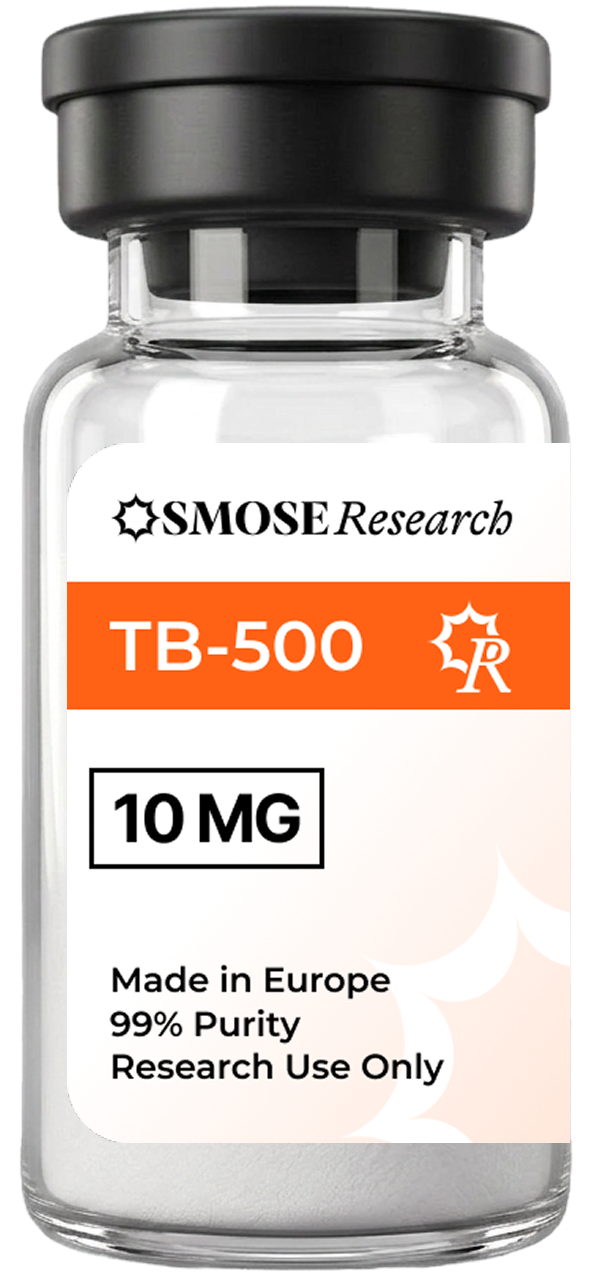
TB-500
2 MGTB-500 — Thymosin Beta-4 fragment for research on cellular migration
Studied therapeutic interests:
Choose quantity
TB-500 is a synthetic fragment (residues 17 to 23, sequence LKKTETQ) of Thymosin Beta-4 (TB-4), a 43-amino-acid polypeptide naturally present in almost all mammalian cells except erythrocytes. Thymosin Beta-4 is one of the most abundant intracellular proteins, playing a major role in regulating the actin cytoskeleton.
This short peptide contains the active fragment of Thymosin Beta-4 responsible for interacting with actin, the main constituent of the cellular cytoskeleton. Preclinical studies have shown that TB-500 binds monomeric G-actin with an affinity of approximately Kd ≈ 2 µM, regulating actin polymerization and depolymerization dynamics essential for cellular movement, wound healing and angiogenesis.
In cellular models, TB-500 has been studied for its effects on migration of endothelial cells (HUVEC), fibroblasts, myoblasts (C2C12) and cardiac progenitor cells. Preclinical tissue repair models include corneal injuries, myocardial ischemia, equine tendon lesions and diabetic wound models.
At OSMOSE Research, TB-500 is supplied as a lyophilized powder with HPLC purity ≥ 99.2%. Manufactured in Europe under GMP standards, this research peptide is delivered under controlled temperature to France, Belgium and Switzerland.
- Preclinical studies on cellular migration
- Actin cytoskeleton regulation research
- Preclinical angiogenesis and neovascularization models
- Studies on cardiac repair after ischemia
- Corneal healing research
- Preclinical tendinopathy and equine tendon injury models
- Skin-repair research in aging
- In vitro endothelial and fibroblast migration studies
TB-500 has generated considerable research interest for its effects on cellular migration and tissue repair. The foundational work of Goldstein et al. (1966-present) characterized Thymosin Beta-4 as a major cytoskeletal regulator. Research topics include: G-actin binding and modulation of actin polymerization, corneal and cardiac tissue repair, angiogenesis via the VEGF pathway, and reduction of fibrosis. Preclinical studies on equine tendon models (horses in sports veterinary medicine) show a 30-50% reduction in healing time. Recent research also explores anti-apoptotic and anti-inflammatory effects in cardiac ischemia/reperfusion models.
- HPLC purity ≥ 99.2% verified by RP-HPLC
- Molecular mass certified by ESI-MS
- Endotoxin test < 0.5 EU/mg by LAL
- Sterility validation
Frequently asked questions
TB-500 is a synthetic 7-amino-acid fragment (residues 17-23: LKKTETQ) of full-length Thymosin Beta-4, which contains 43 amino acids. This fragment contains the active sequence responsible for interacting with G-actin and reproduces the main biological effects of the full protein.
TB-500 contains the KLKKTET sequence which binds monomeric G-actin at the interface between subdomains 1 and 2. This binding, with an affinity of Kd ≈ 2 µM, sequesters G-actin and regulates actin polymerization/depolymerization dynamics essential for cellular movement and cytoskeletal remodeling.
Preclinical studies show that TB-500 accelerates cellular migration to injury sites, stimulates angiogenesis via the VEGF pathway, and reduces fibrosis. These mechanisms are particularly relevant for tissue repair in models of myocardial ischemia, corneal injury, and tendon lesions.
The most common models are HUVEC (human umbilical vein endothelial cells) for angiogenesis studies, C2C12 (mouse myoblasts) for muscle regeneration, primary fibroblasts for matrix synthesis, and cardiac progenitor cells for cardiac repair. Typical concentrations are 10 nM to 1 µM.
Lyophilized TB-500 dissolves in bacteriostatic water, sterile saline or PBS buffer. After reconstitution, the solution is stable for 28 days at 4 °C. For in vitro experiments, typical concentrations range from 10 nM to 1 µM depending on the model.
Yes, TB-500 has generated significant research interest in equine medicine for studies on tendon and ligament lesions in sport horses. Preclinical studies show accelerated healing in horse tendon injury models. Its use remains strictly experimental.
Yes. Preclinical studies show that TB-500 stimulates new blood vessel formation in models of myocardial ischemia and cutaneous wounds. This effect is partly mediated by upregulation of VEGF and migration of endothelial cells.
TB-500 modulates inflammatory responses by reducing pro-inflammatory cytokines (TNF-α, IL-6) and inhibiting the NF-κB pathway. These effects have been documented in preclinical models of cardiac ischemia/reperfusion and intestinal inflammation.
Yes, TB-500 is extensively studied in preclinical cardiac ischemia/reperfusion models. Research documents reduction of infarct size, stimulation of angiogenesis in ischemic zones, and activation of cardiac progenitor cells. These mechanisms position TB-500 as a relevant research tool in cardiology.
Each batch of TB-500 undergoes RP-HPLC analysis with UV detection at 220 nm to verify purity ≥ 99.2%. Mass is confirmed by ESI-MS mass spectrometry, and endotoxin test by LAL method. These analyses are included in the certificate of analysis delivered with each batch.
Complete your research
Often ordered together by our researchers
All products on this page are intended exclusively for in vitro scientific research and laboratory use. They are not intended for human or animal consumption, nor for diagnostic or therapeutic use. The buyer assumes full responsibility for compliance with applicable local regulations.