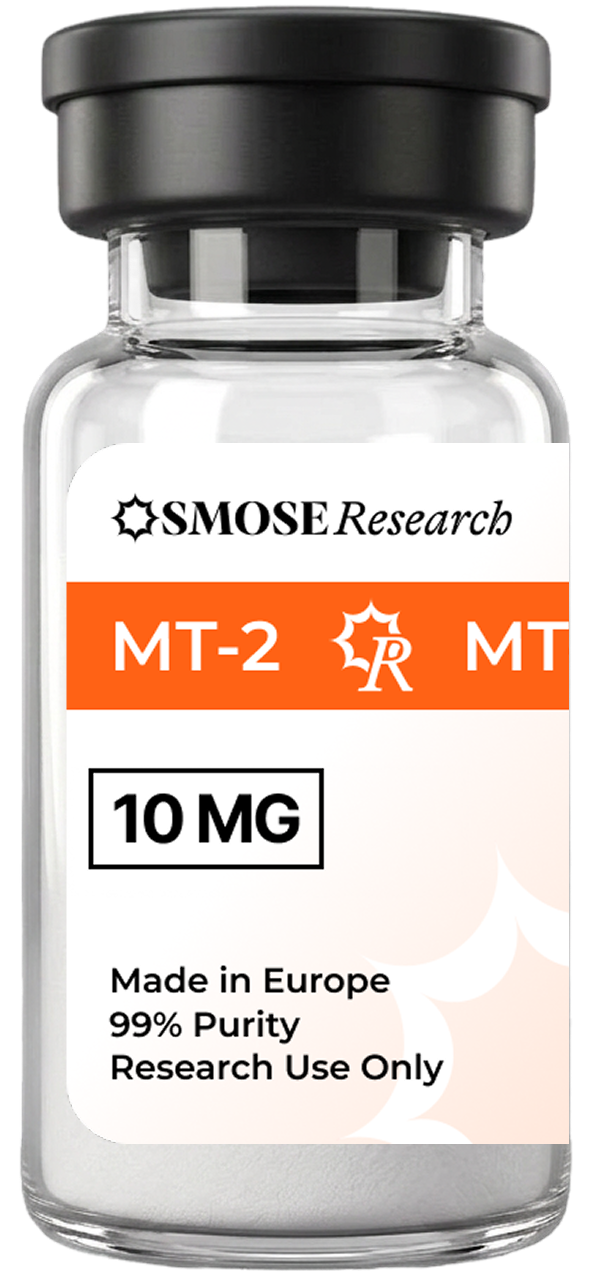
Melanotan-2
10 MGMelanotan-2 (MT2 / MT-II / MTII) — cyclic α-MSH superagonist heptapeptide
Studied therapeutic interests:
Melanotan-2 — also referenced in the literature as MT2, MT-II, MTII, MT-2 or Melanotan II — is a synthetic cyclic heptapeptide (Ac-Nle-cyclo[Asp-His-D-Phe-Arg-Trp-Lys]-NH₂, 1024.18 g/mol) designed as a superagonist analog of the α-MSH melanotropic hormone. Developed at the University of Arizona in the 1990s by the Hadley and Hruby group, MT-II activates melanocortin receptors MC1R, MC3R, MC4R and MC5R with greater metabolic stability than native α-MSH, making it a reference pharmacological tool for the study of melanocortin pathways in in vitro models.
The cyclic structure obtained by a lactam bridge between aspartic acid (position 2) and lysine (position 7) rigidifies the bioactive conformation of the His-Phe-Arg-Trp pharmacophore, common to the melanotropic hormones α-MSH, β-MSH and γ-MSH. The substitution of native methionine by norleucine (Nle) at position 4 and the introduction of D-phenylalanine at position 7 confer remarkable resistance to degradation by serum peptidases.
Preclinical studies published in peer-reviewed journals have demonstrated significant effects on B16-F10 (mouse) and MNT-1 (human) melanocyte lines, where MT-II stimulation at nanomolar concentrations induces a dose-dependent increase in tyrosinase activity and eumelanin production. In HEK-293 recombinant cell models, the EC50 for the MC4R receptor is approximately 0.1 nM, reflecting subnanomolar affinity.
At OSMOSE Research, Melanotan-2 is supplied as a lyophilized powder with HPLC purity ≥ 99.2%, accompanied by a complete certificate of analysis. Manufactured in Europe under GMP standards, this research peptide is delivered to France, Belgium, Switzerland, Luxembourg and worldwide internationally with insulated packaging that preserves molecular stability.
- Preclinical research on melanogenesis and MC1R (B16-F10 models)
- Studies on central food intake regulation via MC4R
- Comparative pharmacology of melanocortin analogs
- In vitro models of cAMP activation and tyrosinase
- Preclinical research on copulatory behavior and MC3R
- Comparative studies with SHU-9119, AgRP and afamelanotide
- Studies on melanocortin receptor desensitization
- Pharmacological characterization of MC1R, MC3R, MC4R, MC5R
Melanotan-2 (MT2, MT-II, MTII) is the most studied melanocortin analog in preclinical research. The foundational work of Hadley, Hruby and Al-Obeidi (1989-present) established its non-selective superagonist profile on MC1R to MC5R, with subnanomolar affinity for MC4R (EC50 ~0.1 nM). Research topics include: melanogenesis via MC1R (B16-F10, MNT-1 lines), central regulation of food intake and energy expenditure via hypothalamic MC4R, exocrine secretion via MC5R, and characterization of the contribution of MC3R to copulatory behavior. Comparative studies with afamelanotide (NDP-α-MSH), SHU-9119 and the endogenous ligand Agouti-Related Protein (AgRP) enrich the dissection of pathway specificity. In vivo, intracerebroventricular (ICV) administration in ob/ob murine models has established the conceptual framework of central leptin-melanocortin pathways (Fan et al., Nature 1997).
- HPLC purity ≥ 99.2% verified by RP-HPLC
- Molecular mass certified by ESI-MS (1024.18 g/mol)
- Endotoxin test < 0.5 EU/mg by LAL method
- Sterility validation
- Cyclization verification (lactam bridge Asp²-Lys⁷)
Frequently asked questions
Yes. MT2, MT-II, MTII, MT-2 and Melanotan II are all abbreviations for the same cyclic heptapeptide Ac-Nle-cyclo[Asp-His-D-Phe-Arg-Trp-Lys]-NH₂ (1024.18 g/mol). These spellings vary by journal and laboratory — they designate the same α-MSH superagonist molecule.
Afamelanotide (NDP-α-MSH) is a 13-residue linear analog with strong MC1R selectivity (Ki ≈ 0.23 nM). MT-II is a 7-residue cyclic analog acting as a non-selective agonist on MC1R through MC5R with subnanomolar affinity for MC4R. MT-II is a privileged tool for central studies, while afamelanotide is preferred for melanogenesis studies.
Cyclization by a lactam bridge between Asp² and Lys⁷ rigidifies the bioactive conformation of the His-Phe-Arg-Trp pharmacophore. This structural preorganization increases affinity for melanocortin receptors and confers greater resistance to exopeptidase enzymatic degradation.
Reference models are the B16-F10 melanocyte line (mouse) and MNT-1 (human) for melanogenesis, HEK-293 transfected with hMC4R for cAMP dosing, and GT1-7 hypothalamic neurons for studies on central feeding regulation.
For MC4R cAMP accumulation dosing, 0.1 to 1 nM is sufficient (EC50 ~0.1 nM). For melanogenesis in B16-F10, 1 to 100 nM over 24-72h. For comparative binding studies, 0.01 to 10 nM. A dose-response curve is recommended for each model.
Melanotan-2 reconstitutes in sterile bacteriostatic water or PBS pH 7.4 (solubility > 1 mg/mL). Typical stock concentration: 10 mg/mL. Avoid vigorous agitation that could denature the cyclic structure. Once reconstituted, stability is 28 days at 4 °C.
For quantitative pharmacology studies (EC50, Ki), purity ≥ 99.2% HPLC is imperative. SPPS synthesis impurities include incorrectly sequenced peptides, non-cyclized linear forms and tryptophan oxidation products — all of which can alter receptor binding measurements.
No. Melanotan-2 is an experimental peptide intended exclusively for in vitro research. It has no MA (ANSM, EMA, FDA). Only afamelanotide (Scenesse®, CUV1647) holds a marketing authorization limited to erythropoietic protoporphyria (PPE) in Europe.
Yes, intracerebroventricular (ICV) administration of MT-II in rodents is a classical model for studying central regulation of food intake and energy expenditure via hypothalamic MC4R. Studies have established the conceptual framework of central leptin-melanocortin pathways.
MT-II has subnanomolar affinity for MC4R: EC50 ~0.1 nM in HEK-293 recombinantly expressing hMC4R. This extreme potency makes it the pharmacological reference for comparing new melanocortin ligands.
Complete your research
Often ordered together by our researchers
All products on this page are intended exclusively for in vitro scientific research and laboratory use. They are not intended for human or animal consumption, nor for diagnostic or therapeutic use. The buyer assumes full responsibility for compliance with applicable local regulations.