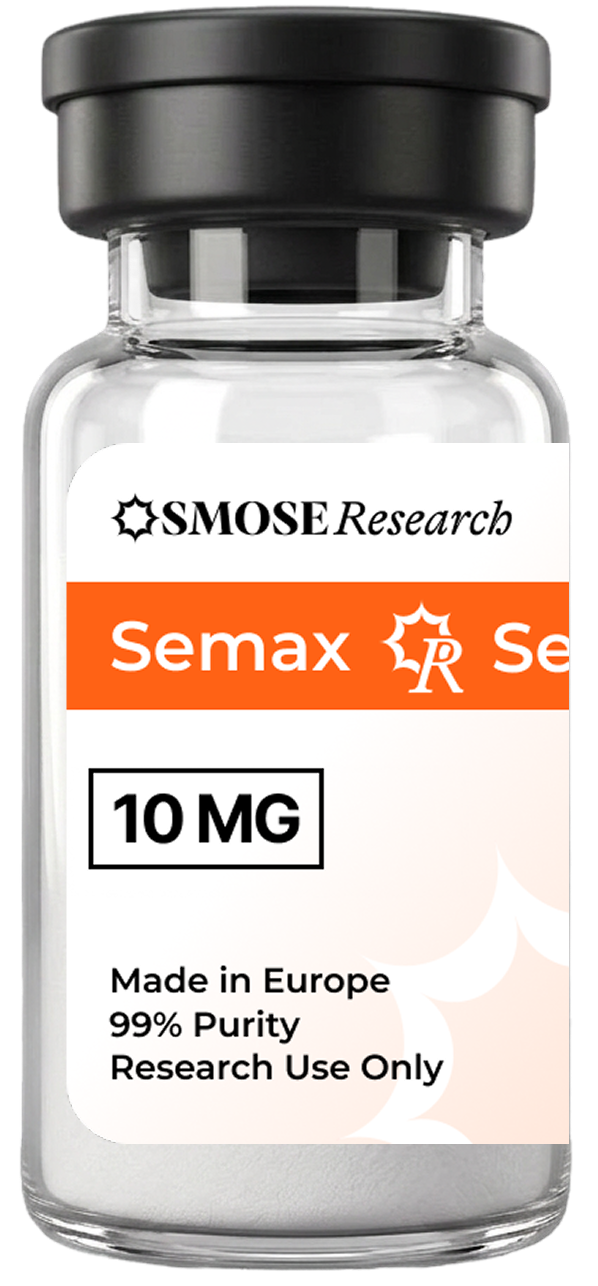
Semax
10 MGSemax (Sémax) — MEHFPGP heptapeptide derived from ACTH(4-10) for research on BDNF/NGF
Studied therapeutic interests:
Semax (also spelled sémax) is a synthetic heptapeptide of sequence Met-Glu-His-Phe-Pro-Gly-Pro (MEHFPGP, 813 g/mol), derived from the ACTH(4-10) fragment of adrenocorticotropic hormone with the addition of a C-terminal Pro-Gly-Pro motif. Developed in 1982 by Ivan Ashmarin and collaborators at the Moscow Institute of Molecular Biology, it is studied in preclinical research as an experimental nootropic peptide with documented effects on neurotrophic factor expression.
The Pro-Gly-Pro motif — a signature of Russian stabilized peptides, derived from neuropeptide Y — confers remarkable resistance to proteases, extending in vivo half-life. Intranasal administration in rats at doses of 50-150 µg/kg increases BDNF (Brain-Derived Neurotrophic Factor) and NGF (Nerve Growth Factor) mRNA expression 2 to 5-fold in the hippocampus within 2-4 hours.
In preclinical research, semax acts via indirect induction of neurotrophins, which activate TrkA and TrkB receptors, creating a positive feedback loop of neurotrophic signaling. It also activates the MAPK/ERK pathway and has been characterized in multiple models: cerebral ischemia, oxidative stress, memory disorders and neuroprotection.
At OSMOSE Research, Semax is supplied as a lyophilized powder with HPLC purity ≥ 99.2%. Manufactured in Europe under GMP standards, this research peptide is delivered to France, Belgium, Switzerland, Luxembourg and worldwide internationally with insulated packaging.
- Preclinical research on BDNF/NGF induction and neurotrophism
- Studies on the MAPK/ERK pathway and TrkA/TrkB receptors
- Neuroprotection models (ischemia, oxidative stress)
- Preclinical research on memory and learning
- Studies on adult hippocampal neurogenesis
- Comparative research on Russian nootropic peptides (semax vs selank)
- Preclinical models of traumatic brain injury
- Studies on visual cortex and ocular neuroprotection
Semax is a major tool in research on neuroplasticity and peptide nootropics. The foundational work of Ashmarin, Nezavibatko and colleagues at the Moscow Institute of Molecular Biology (1982-present) established its stabilized structure and neurotrophic effects. Research topics include: 2-5x induction of BDNF and NGF mRNA expression in the rat hippocampus (Dolotov et al., Brain Res 2006), activation of MAPK/ERK and TrkA/TrkB pathways, neuroprotection in cerebral ischemia and oxidative stress models, and memory improvement in Morris water maze, T-maze and aversive conditioning tasks. Recent studies explore its effects on adult hippocampal neurogenesis, endocannabinoid and enkephalinergic systems, and comparative effects with selank.
- HPLC purity ≥ 99.2% verified by RP-HPLC
- Molecular mass certified by ESI-MS (813 g/mol)
- Endotoxin test < 0.5 EU/mg by LAL method
- Sterility validation
- Sequence verification by MS/MS
Frequently asked questions
Semax was designed in 1982 by Ivan Ashmarin and colleagues at the Moscow Institute of Molecular Biology, based on the ACTH(4-10) fragment of adrenocorticotropic hormone. The addition of a C-terminal Pro-Gly-Pro motif (derived from neuropeptide Y) confers protease resistance and extends half-life.
Preclinical studies (Dolotov et al., Brain Res 2006) show that intranasal administration of semax at 50-150 µg/kg increases BDNF mRNA expression 2-5 fold in the hippocampus within 2-4 hours. The underlying mechanism involves activation of the MAPK/ERK pathway and modulation of BDNF-CREB transcription.
The intranasal route allows direct delivery to the CNS via olfactory and trigeminal nerves, bypassing the blood-brain barrier and rapidly reaching the hippocampus and amygdala. This route is a signature of Russian experimental neuropeptide research.
The Pro-Gly-Pro motif is a signature of Russian stabilized peptides, derived from neuropeptide Y. It blocks C-terminal exopeptidases and extends in vivo half-life. Other Russian peptides (selank, semigasteron) use similar modifications.
Reference models are intranasal administration in rats for hippocampus (BDNF/NGF), Morris water maze and T-maze for spatial memory, cerebral ischemia (MCAO) for neuroprotection, and primary neuronal cultures for studies on the ERK/MAPK pathway.
Semax is derived from ACTH(4-10) and acts via BDNF/NGF induction. Selank is derived from tuftsin and modulates GABA, serotonin and enkephalins. Both share the C-terminal Pro-Gly-Pro stabilizing motif but target different signaling pathways.
Lyophilized semax dissolves in bacteriostatic water or PBS pH 7.4. Avoid prolonged exposure to air and oxidizing agents (methionine at position 1 is sensitive to oxidation). Stability is 28 days at 4 °C after reconstitution.
Purity ≥ 99.2% HPLC is imperative for quantitative studies. Synthesis impurities may include methionine oxidation products (position 1), with formation of sulfoxide (Met-SO) which can alter quantitative measurements.
Yes. Studies explore semax's effects on the visual cortex and retinal neuroprotection in preclinical models of ocular ischemia and glaucoma. These effects are mediated by BDNF induction in retinal ganglion cells.
Semax holds a therapeutic authorization in Russia and Ukraine (Semax®) but does not have European or FDA MA. Outside of these jurisdictions and clinical research protocols, semax is intended exclusively for in vitro research.
Complete your research
Often ordered together by our researchers
All products on this page are intended exclusively for in vitro scientific research and laboratory use. They are not intended for human or animal consumption, nor for diagnostic or therapeutic use. The buyer assumes full responsibility for compliance with applicable local regulations.